New Year is coming and each member of our family 1) reviews and "grades" each of last year's resolutions, and 2) makes resolutions for the coming year. Last year my top resolution was to finish drafts 2 and 3 of The Next Novel in 2010, "without going crazy."
So: how did I do?
I'm still working on draft 3, and I did go a little bit crazy this summer (that is: anxious, overwhelmed, insecure), so I'll likely give myself a C+, or maybe a B-, because, after all, I worked hard.
I aim to finish the novel next year ... but in truth, that's hard to imagine, so I think I'll revise my resolution to "finish drafts 3 and 4." That's safer because there could well be 6 drafts.
Perhaps I won't even say anything about crazy, because that's just part of the process.
Writing a novel is a glacial process, and, as with glaciers, there is a lot unseen under the water.
[Image: Fire Down on The Labrador, 1980, by David Blackwood. Awesome, isn't it?]
. .
My son Chet sent me the link to this video on creativity, which pulled lots of thoughts I'm having right now into place.
The importance of connectivity
A post I wrote on a blog about searching for information on the Theatre of the Marais in 17th century Paris was happened upon by John Golder, a scholar in 17th century French theatre. He himself had been surfing the Net for information about the Theatre of the Marais. He read my blog and contacted me through my website. "Can I help?" Magic words!
Since then I've been on a very steep creative and learning curve, thanks to John ... and thanks to this thing called connectivity. Had I not put my questions out there, had I not made myself available, I would not have learned what I'm learning today.
The importance of desperately seeking
Last spring, in Ottawa, at the Writers' Union AGM, I had lunch with novelist Frances Itani. I said: "You know how when you're writing a novel, the answers just fall into your lap?" She knew exactly what I meant. There is something desperately seeking about the process of writing a novel: Seek and ye shall find.
In the early drafts of my novel, my character makes reference, at the end, to the writer Madame de Villedieu. But that was the only mention, and I wondered about that.
Now, in the midst of my third draft, my character's mother has just joined the Hôtel de Bourgogne, another theatre company, and I needed to know what play this company was about to produce. After some time yesterday I found the name of the play, and after more time yet I finally found the author of the tragedy: Madame de Villedieu.
Bonanza!
It could be said that this morning's work researching Villedieu—instead of writing—was a wasted day, but I don't think so. One thing I learned was that Villedieu was not only an originator of historical novels, but that she worked openly, communicating with her readers and the salons of the day...which comes around to the subject of this post: the importance of connectivity. The video mentions the Paris salons bringing about innovation because of the connectivity encouraged there.
Click, click, click!
Madame de Villedieu is apt only to have a walk-on part in the novel I'm writing now, but I'm tucking her away for the future. For a long time, I've been wanting to write a novel about La Grande Mademoiselle, the King's cousin—trying to write, I should say, for I've hundreds of pages in a drawer—but I could never seem to find the right key, the way into her story. It's possible that Villedieu, who dedicated a play and a novel to this eccentric feminist, might just be that key.
Years ago, I came upon a slender little book titled My Editor, by M.B. Goffstein. It's a poem of few lines, with simple, geometric illustrations, describing the process of working with an editor on revision.
I loved it so much I bought three, thinking of people I knew who might love it too. Now I only have one.
I've been thinking of it a lot, of late, going though the revision of The Next Novel, working with The Taskmaster (editor). The poem evokes the rewriting process as a construction site:
I begin to dig again, and lose myself in the excavation.
Of course the new creation isn't quite right at first, and his editor sends him back to revise.
... my building worries me. It's stone cold, and I cry, "Why not have left it wobbly?"
There is a feeling of integrity in the early drafts that is initially lost in revising, until, with time, a new integrity emerges.
. .
It's fall, and time for me to begin thinking of what research books I'm going to take south with me this winter. What am I going to need as I continue work on The Next Novel?
The technology changes so quickly, my database and library systems have radically changed. Now I note which books are searchable on Amazon.com and which on Books Google. Other books are fully on-line or downloaded onto my computer.
I've a towering stack of books that I've already read and marked with notes. I'm considering photographing the pages: put into EverNote (or DevonThink, possibly?), they would then be searchable. I could scan, but that takes longer.
My luggage lightens, and my computer swells. And as for my head? It's about to explode!
. .
This morning, braced by a good sleep, I went through my manuscript scene by scene, listing the changes I would have to make were I to change the Mortemart mansion to the left bank, where I now believe it did exist. (See my early post: here.)
And decided: I would make the move.
Making the decision is half the battle. Making the changes will be painful, but I like the security of place, the foundation of fact. Plus, there's an excellent floor plan: how delicious.
To see my findings, a map and the floor plan: click here.
. .
Editor Dan, who I will now refer to as The Taskmaster, is taking me through the manuscript revision slowly. The first 40 pages became 100. Now I've only 20 pages to work on—the first chapters of Part II—but it feels like looking up at Mount Everest.
I keep thinking: non-fiction would be so much easier. Easier to describe the dead than to try to bring them back to life.
Once again, I'm somewhat at a loss where to begin, how to begin. One consolation of experience is that I know that once I do, I will feel much more at ease.
Temptation: coffee. I must resist (I've given up caffeine); I'll console myself with breakfast popcorn, the perfect anxiety snack.
I've been struggling with the third draft of The Next Novel, in part because it has been taking me so long to get these first four chapters moving. It's July already!
In off hours, I've been working on a guest blog on the definition of historical fiction, and in going through my files I discovered the first stanza from a wonderful poem by Robert Graves:
To bring the dead to life
Is no great magic.
Few are wholly dead:
Blow on a dead man's embers
And a live flame will start.
I'm blowing on the embers: blowing, blowing … .
To read the rest of "To Bring the Dead to Life," so evocative of the process of writing historical fiction: click here.
I'm still struggling with the first section of The Next Novel. Putting scenes under a microscope, I realize how much I've left unsaid — unimagined.
How exactly do they get into the city? By what route?
Do they need papers?
What are they wearing?
What are they seeing, experiencing, feeling?
Where will they stay the night?
How will they lock up their things?
What about the donkey! Doesn't she need food and water?
On one level the revision process has to do with the big picture: the movement of energy from one scene to another. On another level it has to do with the little picture, the microscopic view, with bringing scenes to life through detail. Both are the work of the 3rd draft.
I often think of Ariel Gore's summation of the writing process: lather and rinse, lather and rinse. I'm at a lather stage, but I wish it were that easy. It feels, instead, like crawling through a story, groping in the dark. It can be painstaking, and often, for me, requires quite a bit of research. It's slow going — but then, as I've said many times before, beginnings are the hardest.
I imagined that I could write the 3rd draft of The Next Novel this summer, but I forgot how difficult the 3rd draft can be: it digs deep. I imagine that the 4th and 5th drafts will be on the down-hill slope, but for now, just starting on the 3rd, it's all up-hill.
It's a little confusing knowing how to proceed. Dan wants me to take my time on the first section. It's only 40 pages, but it's the most important part of the novel. Everything that happens comes out of these pages.
I need a plan. Because so much has to be re-visioned (re-imagined), I decided to retype it, rewriting as I go. I'm aiming to double the length, and then edit, cutting it back. Could I finish this section this month?
I began this morning setting out 10 pages. I had no way of knowing how many pages I might get through in a day. I hoped it would be more, but I thought 10 pages a fair estimate.
I got through 3 and 1/2: at this pace, the 479-page MS will take almost 7 months.
The second draft of The Next Novel is being read right now by Dan Smetanka, a wonderful free lance editor in L.A. Am I nervous? You bet! This is its first public airing. In preparation for the next revision — the third draft — I'm rereading it myself. I've been dreading doing this, but now that I'm a good 100 pages in, I feel more at ease.
Not that there aren't problems, both big and small. I've a lot of work ahead. I marvel at the writers who are able to create a coherent novel in a year or two.
The small problems are almost amusing. Who was the author who advised his daughter, also a writer, to "always make sure that the moon is in the right place"? This is basically saying: attend to the details. I had to laugh: one scene opens in spring and in the course of a few hours moves into fall and then winter. It's a good thing Dan has a sense of humor.
I love my Canadian publisher, HarperCollins Canada. After a winter away, I came home to a pile of mail, including the contract for The Next Novel. I don't get a new book out that often, so I forget how striking the first page of their contracts is. It reads:
We believe that a book's most precious element is its creator; that the publisher's role is to produce a work of lasting value and offer it to the public with confidence and commitment; that the author's opinions on publication matters are relevant and should be heard; and that quality should be as much of the essence as timeliness in this agreement. Our contract expresses these beliefs.
I have piles of notes from my weekend at the wonderful San Miguel Writers' Conference. Very briefly, from Barbara Kingsolver's keynote address on how The Lacuna evolved:
1. She first asked: what are the big questions?
2. She wrote pages and pages on what the novel would be about.
3. As she was doing this, scenes begin to "pop up" and characters appeared.
4. She asked: Who will tell the story? To find the voice, she did a lot of practice-writing.
5. She started, but in bits, not chronologically.
6. Then, when she could see the shape of it, she felt ready to start a proper draft. From this point on (she made it very clear), she was in control — of the story, and of the characters.
7. During all this time she was doing research.
The first draft, she said, was like "hoeing a row of corn." It hurt, like giving birth.
Revision is "where the art happens," making everything fit, "pulling the meaning up." (Again, beautiful.)
Her husband is her first reader, then trusted others.
A problem with early drafts is failing to visualize scenes. She goes through the manuscript, "turning on the lights." (I love this image as well.)
She likes to hold a balance between mystery and revelation —but tends, she confessed, to mystery.
She quoted Chagall: "Great art begins where life leaves off."
I wanted to know more about her work at the sentence level. It is, no doubt, intense. She uses a thesaurus constantly (which interested me).
Right now, I'm reading through the second draft of The Next Novel, editing it. With each pass, I get closer to the meaning. Soon, I'll be going through the scenes, "turning on the lights."
My husband and I have been at the beach for a week. Every morning I have been reading and editing the first draft of The Next Novel. Some days I was pleased, other days the verdict was more "Hummm." The last pages, which I read yesterday, made me shed a few tears (always a good sign). All in all, I think it's a good first draft, and I'm ready to roll up my sleeves and dig in.
There is one character (Wig-Girl) who puzzles me, an invented character I haven't figured out yet. (Most of the other characters in the novel are based in history.) She popped into the story early on. I like her, but I'm not sure what she's doing there. While writing the first draft, I kept trying her out in various roles: as a maid to the dying mother, as a romantic interest of the heroine's brother. None of these really worked, and so I'll cut those scenes, but it was amusing (and surprising!) to see her pop up and then disappear, only to pop up yet again in another guise entirely. It's as if I was auditioning her, trying her out.
Today I'll have another look at my character notes, and especially at the notes I took from Christopher Vogler's wonderful book, The Writer's Journey, on the basic characters that are typically part of any story. (I've put my notes on Docs, here — or here, at: http://bit.ly/5uqIA7.)
How does Wig-Girl fit in? What's her role? I've never followed Vogler's template closely, but I do love it, and I find it helps clarify characters and their purpose, their function in the story. It's one of my favorite books on writing.
. . Now that I have finished the first draft of The Next Novel, I'm awash with doubts. I don't think I've gotten to the heart of the story.
What about ... ?
And shouldn't she have ... ?
Etc. etc. etc.
I shouldn't actually question this: of course I haven't gotten to the heart of it!
I've read two excellent on-line accounts recently by authors who went through painfully long revision processes. The first is Junot Díaz's account of writing The Brief Wondrous Life of Oscar Wao. He struggled with this novel for five years, then gave up ... gave up writing entirely. Then ...
"One night in August, unable to sleep, sickened that I was giving up, but even more frightened by the thought of having to return to the writing, I dug out the manuscript. I figured if I could find one good thing in the pages I would go back to it. Just one good thing. Like flipping a coin, I'd let the pages decide. Spent the whole night reading everything I had written, and guess what? It was still terrible."
And then five more years of revisions ... to overnight success.
The second is a wonderful blog entry by writer Gail Carson Levine on finding the right point-of-view for a story she was writing on Snow White. Three hundred pages from the POV of a dwarf. Scratch. Three hundred more from the POV of the prince. Scratch. Three hundred in omniscient. Scratch. And finally: success, from the POV of Snow White in her coma.
"The point is that POV can be hard to figure out and may not be possible to decide on in advance. You may have to try telling your story one way and another (and another and another) until you find out. There may be no shortcut for a particular book."
.. . Spurred on by the possibility that I might not be typing out the sacred words "The End" before we head south at the end of October, I've been writing over 2000 words a day. And I have to say: that takes (me) all day, and most of the evening, as well. That's eating on the run, dressing on the run, relaxing on the run.
But I did it: 2 chapters in 2 days. (My chapters are shorter than most.) I hope to finish another chapter tomorrow. My husband is away, and I'm taking advantage of the solitude. I begin to think I can do it, finish before the commotion of transition.
.. Jerry Cleaver, author of Immediate Fiction, notes emphatically that emotion defines a character:
Who does she love & hate? How does she love & hate?
It's in this realm of emotion that I'm most withholding in my fiction. It has to be dragged out of me every time! This time, I'm going to try to overdo it, at least at the start.
This quote from Immediate Fiction is spot on:
If you go too far out with your story, you can always cut back. An old writing rule says: The best way to find out what's enough is to do too much.
I need to keep this in mind this summer while writing the first draft. No brakes!
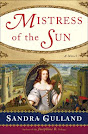
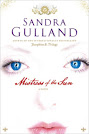
. . Iris, my editor and publisher, just emailed me that Mistress of the Sun was #1 on the Globe and Mail Historical Fiction list! She and Norma, the receptionist at HarperCollins Canada, "enjoyed the sight of it for several minutes," and then Norma pointed out that Under the Sun by Sandra Gulland was also on the list, further down. "We are mystified by this," Iris wrote, "an error on someone's part. But, you have to admit it's pretty nice to be in two places on one bestseller list."
I do indeed! I jokingly wrote back that if The Next Novel were titled Under the Sun it could be called a bestseller before it was even written, much less published.
. . I spent most of today revising, yet again, the "outline" of The Next Novel, which I'm now calling The End of Magic. I do love a rainy Sunday: it's a good excuse to putter in the office all day. I got out for a bit to plant potatoes and peas, but that was pretty much it.
And reading, of course. I'm browsing the books I left out last October, one on the breakfast counter (Pen on Fire), another on the bedside table (John Truby's The Anatomy of Story). I finished The Gathering by Anne Enright, and The Shortest Distance Between You and a Published Book by Susan Page, who I know in San Miguel.
I've been hearing good things about The Shortest Distance for some time, so I'm happy to have been able to read it, at last. It didn't disappoint. It's a very down-to-earth book on getting published — the nuts and bolts of it. I recommend this book. I learned some important things from it.
I especially liked the chapter titled "Procrastination" — for obvious reasons! Susan writes about "acedia" (uh-see-dee-uh), the painfully slow movements required to begin a new project (or to return to a project after a break). It's simply part of the creative process. Procrastination is resistance to doing something. Acedia is a slow giving into it, a letting go of resistance. My own feeling is that resistance is the first step in the creative process, and (now that I have this new word) acedia is the second. I'm sort of in-between the two right now.
I'm pleased with my "outline," but there are things about it that certainly aren't right. I want to tighten, hone. While it was printing, I picked up Truby's The Anatomy of Story (peppered with post-it note thoughts about my abandoned novel about La Grande Mademoiselle: my ghost!). I've yet to get beyond the second chapter, "Premise," because it is so dense: there is so much to try to work out: What is the premise of the novel? What are the possibilities? What is the designing principle? What is the conflict? The basic action? The character change? The moral choice?
So Truby's book is peppered once again with post-it notes, but on The End of Magic. Working through these questions -- or rather, trying to work through them -- I begin to question my entire outline. I'm ready to revise it even as the last page slides out of the printer.
I made a four-year chart this morning — blocking off periods of time for drafts 1, 2, 3, 4 and 5, and then, boldly, sketching in: publish!
I've been anxious ever since.
I could well be turning 68 when The Next Novel sees the light of day. Will there be another novel after that? Will I continue to publish into my 70s? It's hard work — really hard! both in the creation and the publication — and, for the first time, I begin to see that I'm not on a path that extends into infinity.
I had an idea, once, that I would write shorter pieces as a grew older: novellas, short stories, poetry. There is wisdom in this. Perhaps The Next Novel should be titled The Last Novel ... or, at least, The Last Long Novel, for it seems, yet again, a huge subject to come to terms with, an insurmountable, impossible task.
But that feeling, I know, is Stage One. It's a mistake, I think, for a writer to look too far into the future. I know that once I begin, once I'm "on the page," all those anxious thoughts slip away and simple curiosity (and a good measure of delight) will take over.
. . What really impressed my 28-year-old son? My book on the best-seller list? NO: My Tweets making a Mashable list.
I haven't been Twittering for long — since January, perhaps?
For those of you who don't know Twitter, it's a social networking site where posts can only be 140 characters long (as I recall): i.e. short. Obviously not conducive to big words, much less sentences — much less serious thought.
But it's fun, rather in the manner of a hot ping-pong match. In fact, it's become rather too much fun, I'm afraid (as in addictive). Luis Alberto Urrea, for example, author of The Hummingbird's Daughter — a novel I love — regularly posts, plus a host of other writers and publishing-related folk. I'm star-struck. I admit it.
So today I got four Tweets in a row from Susan McKinney, a writer friend in San Miguel: Did you know ... ?!?
Apparently I'd made a list of authors on Twitter.
Oh? (So?)
I found the list, but it took some time to find myself. (Way at the bottom, under Miscellaneous — annoying.) But the list itself was interesting. "Literary Tweets: 100+ of the Best Authors on Twitter," put out by Mashable, which I'd only vaguely heard of.
I emailed my son, Net Guru in NYC. He immediately wrote back: Oh. My. God. This may be the coolest thing (in my books) you've done!
Which woke me up a bit. Really? Not the best-seller list, but a Mashable list?
And so, I have to admit, it has been quite a day. If you're at all inclined, come Twitter with me in the "Twitterverse." I'm at:
http://twitter.com/Sandra_Gulland
Now that I'm official, I'm going to endeavour to Tweet in a more — ahem — literary manner.
(And perhaps, when I'm dawdling writing The Next Novel, you might ask: "Too much time on Twitter, Madame Author?")


 Posts
Posts