.
.
Three authors have emerged, lately, as former spies. Noel Coward was an informant, sent by the British across Europe, and returning to report what was being said about the Nazis. As a society star, he was well-placed to gossip. After 1939, he became a fully-trained member of the secret service, along with Ian Fleming.
The third author is a surprise to me: Peter Matthiessen, author of At Play in the Fields of the Lord (a novel I loved). For two years, he worked for the CIA. His cover? Being co-founder and editor of The Paris Review. The prestigious literary magazine was founded in 1953, well past WWII, so what motivated him?

Tuesday, April 29, 2008


Monday, April 28, 2008
On airport bookstores
.
.
I cannot pass a bookstore without browsing, and for a few moments in a Virgin bookstore in the Vancouver airport, I loose myself in the titles. And then I wake up: I'm an author, I've a new book just published, is it on the shelves?
No.
I can't believe it. How is that possible? It's not that it's a hardcover, for they do have other hardcover fiction titles displayed, and published by my own publisher — titles not on the Maclean's best-selling fiction in Canada list for over two months, I note with angry jealousy. For a crazy moment I consider inquiring of the clerk, and imagine her saying, Oh, we just can't keep it in stock, it flies off the shelves. Instead I skulk away, pouting.
It's amazing how emotional this can be. I'm not this type of person — normally. But normally, too, I'm not on a book tour, I don't have a book out, and normally I do not have a book on anyone's best-seller list. A sense of entitlement comes quickly ... and lethally.
I remember walking in a mall with my then-young son just before my first book was to be published. Passing a bookstore I told him, "Next time we come, my book will be in that store." I realized, then, that my bookstore experience would change forever. No longer, relaxed and easy browsing. Once I had a book published, I would approach bookstores as an Author, making sure I was presentable, checking to see if my titles were on a table or shelf, and then going up to the clerk and explaining that I was the author of a book on their shelf (pointing), and offering to sign.
It's a job, what you do. My experiences have been varied, from the manager of a large store jumping up and down with enthusiasm, to an annoyed end-of-day who-needs-this response from a clerk. More and more, I'm asked to prove my identity first with an ID before being allowed to sign.
I came to see airport bookstores as the cream of the crop, and longed for the day when my books would be in one. I remember with great satisfaction when I first saw the titles of the Josephine B. Trilogy on the shelf of a bookstore in a San Francisco airport. As the Trilogy became more successful, I began to even expect to see it.
And so, grumpily, I left the Virgin bookstore in the Vancouver airport and proceeded through check-in. There was another bookstore on the way to my gate: I glanced over the shelves warily. No. No. No.
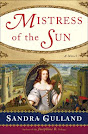
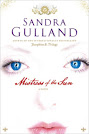
And then: yes. There is was, Mistress of the Sun stacked ever so nicely on a shelf at the front.
Happily, I got on the plane.
.
I cannot pass a bookstore without browsing, and for a few moments in a Virgin bookstore in the Vancouver airport, I loose myself in the titles. And then I wake up: I'm an author, I've a new book just published, is it on the shelves?
No.
I can't believe it. How is that possible? It's not that it's a hardcover, for they do have other hardcover fiction titles displayed, and published by my own publisher — titles not on the Maclean's best-selling fiction in Canada list for over two months, I note with angry jealousy. For a crazy moment I consider inquiring of the clerk, and imagine her saying, Oh, we just can't keep it in stock, it flies off the shelves. Instead I skulk away, pouting.
It's amazing how emotional this can be. I'm not this type of person — normally. But normally, too, I'm not on a book tour, I don't have a book out, and normally I do not have a book on anyone's best-seller list. A sense of entitlement comes quickly ... and lethally.
I remember walking in a mall with my then-young son just before my first book was to be published. Passing a bookstore I told him, "Next time we come, my book will be in that store." I realized, then, that my bookstore experience would change forever. No longer, relaxed and easy browsing. Once I had a book published, I would approach bookstores as an Author, making sure I was presentable, checking to see if my titles were on a table or shelf, and then going up to the clerk and explaining that I was the author of a book on their shelf (pointing), and offering to sign.
It's a job, what you do. My experiences have been varied, from the manager of a large store jumping up and down with enthusiasm, to an annoyed end-of-day who-needs-this response from a clerk. More and more, I'm asked to prove my identity first with an ID before being allowed to sign.
I came to see airport bookstores as the cream of the crop, and longed for the day when my books would be in one. I remember with great satisfaction when I first saw the titles of the Josephine B. Trilogy on the shelf of a bookstore in a San Francisco airport. As the Trilogy became more successful, I began to even expect to see it.
And so, grumpily, I left the Virgin bookstore in the Vancouver airport and proceeded through check-in. There was another bookstore on the way to my gate: I glanced over the shelves warily. No. No. No.
And then: yes. There is was, Mistress of the Sun stacked ever so nicely on a shelf at the front.
Happily, I got on the plane.
On the Road (at 63): travel advice for ageing authors
.
.
An unhappy thumb is a wonderful problem to have to deal with, since it's caused by swarms of fans wanting their book signed. The Calgary reading was one of my favorites — intimate, yet of a good size. They forgave my stumbling delivery. (Note to self: write my talk out, experiment with reading different sections, practice.) And then they bought books and lined up to have them signed.
I write out names before I sign because people often want me to sign more than one, and I fear misspelling a name. And so I have a record, neatly recorded in the lovely Moleskin I thought would be for recording thoughts about my next novel, but was rather quickly taken over by promotion notes. So: at my Toronto launch in February, I signed for 28. This was considered a smashing success: many had more than one book to be signed, and several, as well, only wanted a signature.
In Calgary, however, I signed for 46! Many, many of these were for more than one book. It seemed like I was signing for a very long time — an hour and a half? (Impossible, surely.)
The next morning, in Vancouver, my right thumb showed signs of stress. This worried me: if my thumb completely gives out, I'm incapable of shaking a hand, much less holding a pen — much less writing.
Add to survival gear list: an ergonomic pen.
.
An unhappy thumb is a wonderful problem to have to deal with, since it's caused by swarms of fans wanting their book signed. The Calgary reading was one of my favorites — intimate, yet of a good size. They forgave my stumbling delivery. (Note to self: write my talk out, experiment with reading different sections, practice.) And then they bought books and lined up to have them signed.
I write out names before I sign because people often want me to sign more than one, and I fear misspelling a name. And so I have a record, neatly recorded in the lovely Moleskin I thought would be for recording thoughts about my next novel, but was rather quickly taken over by promotion notes. So: at my Toronto launch in February, I signed for 28. This was considered a smashing success: many had more than one book to be signed, and several, as well, only wanted a signature.
In Calgary, however, I signed for 46! Many, many of these were for more than one book. It seemed like I was signing for a very long time — an hour and a half? (Impossible, surely.)
The next morning, in Vancouver, my right thumb showed signs of stress. This worried me: if my thumb completely gives out, I'm incapable of shaking a hand, much less holding a pen — much less writing.
Add to survival gear list: an ergonomic pen.
The true danger of travel
.
.
One night "on the road" and already I fear I'm coming down with a cold. This two-stop tour (Calgary, Vancouver) is something of a test run. The big tour will be in June – four and a half weeks of travel and promotion from New York to San Francisco. I can see that one of the (many) challenges will be staying healthy, given all the different hotels with variable temperatures, all the hand shaking and closed airplane air, all the late nights and early mornings — not to mention the excitement and consequent stress.
I add to my survival gear list: Echinacea (with Golden Seal, made in our local area by St Francis Herb Farm: the best), Tea Tree oil (vile even in drops, to gargle). And Airborne, which I still believe in.
.
One night "on the road" and already I fear I'm coming down with a cold. This two-stop tour (Calgary, Vancouver) is something of a test run. The big tour will be in June – four and a half weeks of travel and promotion from New York to San Francisco. I can see that one of the (many) challenges will be staying healthy, given all the different hotels with variable temperatures, all the hand shaking and closed airplane air, all the late nights and early mornings — not to mention the excitement and consequent stress.
I add to my survival gear list: Echinacea (with Golden Seal, made in our local area by St Francis Herb Farm: the best), Tea Tree oil (vile even in drops, to gargle). And Airborne, which I still believe in.
Test Tour
.
.
Mr. Seat by the Window calls out and waves to all the crew. "Hey, Joe! Nice to see you!" He obviously lives on WestJet — which, I can attest, is a perky sort of airline (superior, in my view, to grumpy Air Canada). I quickly dig out my earplugs and open a book. I think of Alexander McCall Smith, who writes on airplanes. I think of Margaret Atwood, who writes poetry on tour. "What else is there to do?" They are the gold metal winners of the tour circuit. I'm just aiming to get through it in one piece.
I begin a list of survival gear: iPod, earplugs. I will need a purse/backpack that fits under the narrow aisle seat I now favor, something sturdy I can put my feet on (given that the seat heights are too tall for me, designed for men). A shawl and slipper socks for when it's cold; a layer I can slip off when it's hot.
I've chosen an excellent novel for travel — The Book Thief — but it's too fat. I need a slender yet engaging book. I remember traveling through Europe with War and Peace, tearing off pages as I read them, returning home with a few pages and the back cover — but I don't want to do that with this book. This is a book to pass on.
(Written last Thursday, but not posted.)
.
Mr. Seat by the Window calls out and waves to all the crew. "Hey, Joe! Nice to see you!" He obviously lives on WestJet — which, I can attest, is a perky sort of airline (superior, in my view, to grumpy Air Canada). I quickly dig out my earplugs and open a book. I think of Alexander McCall Smith, who writes on airplanes. I think of Margaret Atwood, who writes poetry on tour. "What else is there to do?" They are the gold metal winners of the tour circuit. I'm just aiming to get through it in one piece.
I begin a list of survival gear: iPod, earplugs. I will need a purse/backpack that fits under the narrow aisle seat I now favor, something sturdy I can put my feet on (given that the seat heights are too tall for me, designed for men). A shawl and slipper socks for when it's cold; a layer I can slip off when it's hot.
I've chosen an excellent novel for travel — The Book Thief — but it's too fat. I need a slender yet engaging book. I remember traveling through Europe with War and Peace, tearing off pages as I read them, returning home with a few pages and the back cover — but I don't want to do that with this book. This is a book to pass on.
(Written last Thursday, but not posted.)
Monday, April 21, 2008
Ishiguro interview in The Paris Review
.
.
I've long loved The Paris Review interviews, but I've acquired a habit of counting the male/female balance of those interviewed, and often that's enough to turn me away. The current issue isn't any different: 7 men in bold on the cover, to 1 woman (Katie Ford, author of a beautiful poem "Earth").
However, the feature interview is with Kazuo Ishiguro, an author I greatly admire. Indeed, he is one of the few male authors who can write absolutely convincingly from a female point-of-view — so convincingly, in fact, that I could not believe that his first novel, A Pale View of Hills, was written by a man. He continues to astonish with every novel he publishes.
Here are some snippets from "The Art of Fiction" that caught my interest:
The PR interviewer asked how the English setting for The Remains of the Day came about, and Ishiguro said that it started with a joke that his wife made.
At this point in the on-line interview, I must chose to purchase the print edition of The Paris Review in order to read what follows. I do, selecting "state" of Ontario (is this a plot?), and scrolling up the long list of countries from the pre-selected U.S.A. to find Canada. Now I'll have to wait for the print issue to arrive the old-fashioned way, by burro-express.
.
I've long loved The Paris Review interviews, but I've acquired a habit of counting the male/female balance of those interviewed, and often that's enough to turn me away. The current issue isn't any different: 7 men in bold on the cover, to 1 woman (Katie Ford, author of a beautiful poem "Earth").
However, the feature interview is with Kazuo Ishiguro, an author I greatly admire. Indeed, he is one of the few male authors who can write absolutely convincingly from a female point-of-view — so convincingly, in fact, that I could not believe that his first novel, A Pale View of Hills, was written by a man. He continues to astonish with every novel he publishes.
Here are some snippets from "The Art of Fiction" that caught my interest:
I’ve never felt that I have a particular facility at writing interesting prose. I write quite mundane prose. I think where I’m good is between the drafts. I can look at one draft, and I have lots of good ideas for what to do with the next one.I find that reassuring. (I'd like to know how many drafts he might write.)
The PR interviewer asked how the English setting for The Remains of the Day came about, and Ishiguro said that it started with a joke that his wife made.
There was a journalist coming to interview me for my first novel. And my wife said, Wouldn’t it be funny if this person came in to ask you these serious, solemn questions about your novel and you pretended that you were my butler? We thought this was a very amusing idea.He became obsessed with the idea of a butler as a metaphor for classical British reserve, but also as someone who serves loyally, without any responsibility for the larger issues. He did a lot of research,
but I was surprised to find how little there was about servants written by servants ... . It was amazing that so few of them had thought their lives worth writing about. So most of the stuff in The Remains of the Day about the rituals of being a servant was made up. When Stevens talks of the “staff plan,” that’s made up.I've long had trouble finding information on what it was, exactly, servants did, so I find this interesting. I'm considering writing about a man who was a loyal secretary to my character — his role would have been similar to that of an English butler.
At this point in the on-line interview, I must chose to purchase the print edition of The Paris Review in order to read what follows. I do, selecting "state" of Ontario (is this a plot?), and scrolling up the long list of countries from the pre-selected U.S.A. to find Canada. Now I'll have to wait for the print issue to arrive the old-fashioned way, by burro-express.
Sunday, April 20, 2008
Reading: the first step
.
.
A friend who teaches writing was puzzling over a student who worked hard, but just "didn't have it." It turns out this student doesn't read.
I'm astonished by people who wish to be writers, but don't read as a rule. That would be like wanting to be a musician, but not listening to music, or wanting to be a chef, and not enjoying food. By reading, a writer develops an instinct for what works ... and what doesn't. And why write if one doesn't enjoy reading? It's incomprehensible to me.
I often advise people who want to write, to write what they read. Often this ruffles — my suspicion is that they read commercial or genre fiction, and imagine themselves above that, on a so-called higher literary plane. If that's the case, then that is the type of book they should be reading.
As a writer, one begins to read differently: for pleasure (always), but also for craft. I note changes in point-of-view, challenging structures. (The book Reading Like a Writer by Francine Prose is excellent, as is Jane Smiley's Thirteen Ways of Looking at the Novel.)
Right now I'm reading The Boys in the Trees, by Mary Swan, and I'm reading it in a reverie of awe. It's a brilliant book: she's a brilliant writer. As a writer myself, it's thrilling — and yes, humbling, I admit — to encounter a work of such daring reach. I'm studying the way she's able to change point-of-view, the heart-stopping structure (the main characters abruptly changing a third of the way in!), the nuanced, rich details. Just gorgeous. Bravo!
.
A friend who teaches writing was puzzling over a student who worked hard, but just "didn't have it." It turns out this student doesn't read.
I'm astonished by people who wish to be writers, but don't read as a rule. That would be like wanting to be a musician, but not listening to music, or wanting to be a chef, and not enjoying food. By reading, a writer develops an instinct for what works ... and what doesn't. And why write if one doesn't enjoy reading? It's incomprehensible to me.
I often advise people who want to write, to write what they read. Often this ruffles — my suspicion is that they read commercial or genre fiction, and imagine themselves above that, on a so-called higher literary plane. If that's the case, then that is the type of book they should be reading.
As a writer, one begins to read differently: for pleasure (always), but also for craft. I note changes in point-of-view, challenging structures. (The book Reading Like a Writer by Francine Prose is excellent, as is Jane Smiley's Thirteen Ways of Looking at the Novel.)
Right now I'm reading The Boys in the Trees, by Mary Swan, and I'm reading it in a reverie of awe. It's a brilliant book: she's a brilliant writer. As a writer myself, it's thrilling — and yes, humbling, I admit — to encounter a work of such daring reach. I'm studying the way she's able to change point-of-view, the heart-stopping structure (the main characters abruptly changing a third of the way in!), the nuanced, rich details. Just gorgeous. Bravo!
Friday, April 18, 2008
Process and product
Of course I said, It's never too late ... and I believe that to be true. I told her that even one-half hour a day is all it takes ... and I believe that to be true, as well.
I woke up this morning thinking of this conversation: thinking, as well, that it came down to process versus product. It's never too late to engage in the process of writing. But the product: this is what stops people, and I don't believe that it should.
By product, people think agent, publishing house, editors, production, promotion ... all of that. They also assume — although it's not always the case — that there is profit involved, money to be earned by the writer. Somehow this confers legitimacy. And it does — I'm not going to argue that — but it's not the only legitimacy.
I think of a book that once meant a great deal to me, in my teens: To Paint is to Love Again, by Henry Miller. (Miller's full quote is, "To paint is to love again, and to love is to live life to its fullest.") Although I don't know for sure, I believe this was initially a self-publication. No doubt I could have an entire blog dedicated to wonderful books that were self-published. Margaret Atwood and friends started a magazine in order to be able to publish their work. Today, self-publishing is an art form: you can have so much control, and it doesn't cost very much. It's no longer "vanity publishing" — but rather more like an indy movie. And however it's viewed, it's a legitimate creation.
Which led me to think of my own long-time dream of "Log Cabin Press." I can immediately think of a number of titles — all my own, for I have no desire to be applied to by others, to have to accept or reject, to edit the work of others. That becomes work, and this is all about process, and the creative culmination of that process.
The first title that comes to mind is Bone Magic, the short story that became Mistress of the Sun.
Another is The Book of Books, a compendium of essays about my mother, illustrated with her paintings and other creative work.
Another is The Clown's Mother, a book of memories about my mother's mother, my grandmother May.
And the last would be Confessions of an Airhead, my own autobiography.
Vanity press? Yes, in a way, because these would all be intensely personal works, but all the more legitimate, for that.
I think, ultimately (and not a little sadly), of the opening lines of a poem, "Undid in the Land of Undone" by Lee Upton:
All the things I wanted to do and didn't
took so long.
It was years of not doing.
I began writing because I imagined my tombstone with the words, She never got around to it. So: I must ask myself, What's next? I do want to write at least one more Sun Court novel, but I also want to complete these Log Cabin Press creations ... not for profit, not for fame, but for myself, and for those near and dear.
Wednesday, April 16, 2008
Art about Writing

Tuesday, April 8, 2008
The importance of images
 The painting Pegasus by William Blake is an evocative image, I think, for Mistress of the Sun: I see Petite in the clouds, handsome Louis, and, of course, an enchanting white horse. (I would be thrilled if this image was used by a publisher for the cover.)
I didn't come across this beautiful painting until Mistress was in production; otherwise, I would have pinned a print above my computer. I have always regarded this novel as something of a fable , and that's the feeling that this painting gives.
 Another painting, also of a white horse — Tête de cheval blanc by Géricault — was pinned above my desk, and for all those years that I was working on Mistress, I imagined that this image would be the cover.
"Cover" image, working title, the story itself invariably change, but they are important to me while writing. I write a dedication first thing, as well. This, too, will change over time, but I need to feel that what I'm writing is, in fact, a book, and the more I can approximate one visually, even in the very messy early stages, the more ardently I apply myself to the task at hand.
This image of a white horse was important in other ways; I felt it was my "key" into the novel. I discovered it on a postcard in the Louvre gift shop. I was on my last research trip for The Last Great Dance on Earth. I dreaded finishing that novel, knowing that my long-term and intimate relationship with Josephine and her world would come to an end. I was in tears leaving the room where David's magnificent painting of the Coronation of Empress Josephine was displayed at the Louvre.
 This painting has to be seen to be experienced. It appears life-size. "One walks into it," Napoleon said. I knew all the characters so well, I felt I was there with them. I also knew that when I returned — if I returned — I would view it as an outsider: hence the tears. As I left the museum, I stopped in the gift shop, needing time to collect before facing the bustling world. I spotted the postcard of Tête de cheval blanc and latched onto it, seeing in it the lifeline to my next novel, my next world.
Monday, April 7, 2008
On dream-storming
About two years ago I read a book on writing that included a card technique for this initial process that appealed to me: From Where you Dream, by Robert Olen Butler.
It's Chapter 5 that interests me, "A Writer Prepares": which is exactly what I need to do. The technique is "dream-storming": investing 6 to 12 weeks or so (i.e. serious time) just dreaming up scenes, a good 200 or so. The next step is put them on cards, spread them out and begin to find the shape of the story.
What I like about this approach is that as you write, and when the story begins not to work (like immediately), you stop and re-dream it, so the plot is not a fixture, but an organic thing that keeps changing. Which, of course, it does anyway, but I'd like not to spend eight years trying to sort it out this time. What I'd like is to dream the story this year and write it the next, second and third drafts the year following.
But first, I must actually begin.
Thursday, April 3, 2008
Languages
I find learning languages challenging, and this winter has been particularly rigorous because I've had to learn Net-ease and rudimentary HTML. Promoting a book requires "getting out there," and these days, out there is here, on the Net, which has a language of its own.
Subscribe to:
Posts (Atom)


 Posts
Posts