Notes on the Writing Life: June 2009

Notes on the Writing Life

Notes on the Writing Life

Sunday, June 28, 2009

More from "Immediate Fiction"

. .
Jerry Cleaver, author of Immediate Fiction, notes emphatically that emotion defines a character:
Who does she love & hate?
How does she love & hate?
It's in this realm of emotion that I'm most withholding in my fiction. It has to be dragged out of me every time! This time, I'm going to try to overdo it, at least at the start.

This quote from Immediate Fiction is spot on:
If you go too far out with your story, you can always cut back. An old writing rule says: The best way to find out what's enough is to do too much.
I need to keep this in mind this summer while writing the first draft. No brakes!

Thursday, June 25, 2009

On rewriting: did you know ... ?

.
.
I was surprised to learn in Cleaver's Immediate Fiction that John Fowles, author of The Collector and The French Lieutenant's Woman, rewrote The Magus ten years after it had been published to great success. There are two versions of The Magus in print, apparently: an astonishing thing. The second version was a best-seller as well.

I can well understand thinking about how a story might have been written, but can't imagine going back, not after it has been published.

Wednesday, June 24, 2009

Want/obstacle/action

.
.
Yesterday I finished the outline — or "blueprint" — of The End of Magic, working title of The Next Novel. Sixty pages! (Although there is lots of white space.) Twenty drafts! (Although many of these involved minor changes.)

Now it's time to move back to our country home and get to work. I've allowed myself four months to write the first draft.

One of the things I've enjoyed about our two-month stay in Toronto is use of the Toronto Public Library system. It's so easy to request a book on-line, so easy to pick it up. Jennifer Glossip, a wonderful fiction editor I've known for decades, shared with me the list of good books on fiction she gives out at workshops. A number of these titles were my favorites, as well, but several I hadn't heard of ... and so I've been having a look at some of them.

The one book that I gobbled up, covering it with post-it notes, was Immediate Fiction by Jerry Cleaver. It had an immediate impact on my outline. What do my characters want? What is the obstacle? What action results?
Want/obstacle/action ...
These need to be evident on every page.

What I love about reading a book like this is that it sets off ideas, sparking like mad. I'll be posting more about this book in days to come.

Saturday, June 13, 2009

R.I.P. Readerville.com

Readerville.com has been an important on-line community for me for a very, very long time. It came as a shock to me when it folded. I've made lasting friendships there, so in that respect it lives on.

What also lives on is the wonderful Readerville Journal. It's invariable captivating. For example, an article noting a wonderful blog, How books got their titles (http://garydexter.blogspot.com/). Ever wonder why The Medium is the Massage isn't The Medium is the Message?
Massage? Shouldn’t that be ‘message’? Well, yes, it should. When the book came back from the typesetter there was a misprint in the title. According to his son Eric, McLuhan took one look at it and exclaimed, ‘Leave it alone! It's great, and right on target!’.
This is an amazing blog. The author, Gary Dexter, is quite a researcher. "Why not Catch 21?" How can one resist?
One of the things I loved about Readerville.com is that I learned so much: the same goes for Readerville Journal. Bravo!

Thursday, June 11, 2009

101 Habits (last installment): On showing up at the office

.
.
The most lasting "habit" I think I'll keep for myself from The 101 Habits of Highly Successful Screenwriters has to do with how I think of my work.

At some point — I can't find the spot — one of the writers said that writing is scary, and that it helps temper the fear by thinking that you're doing it for money. I think there is something in that.

The other suggestion that I'm going to keep in mind is that when I finish the first draft of The Next Novel, I could work on another project. I could go back to puzzling over the plot of my abandoned novel on La Grande Mademoiselle, or develop any number of other stories that I would love to write. It's important to put a draft aside for a long period of time, but that doesn't mean everything comes to a halt.

Another screenwriter advised thinking of your writing as a corporation: you're expected to show up and get to work. These practical thoughts have stayed with me. Lately, I've been telling myself, "I had a good day at the office today." Or, "I have to get back to the office."

So: if I'm not here, it's because I'm at the office.

Tuesday, June 9, 2009

101 Habits (continued): on character

.
.
On character:
"Another reason why scripts fail is that the lead character's need, motivation, or goal is often not clear. You have to know what they want, no matter what it is or how goofy it is. And if you don't care about what they want, you won't be emotionally invested in the character." [Amy Holden Jones, page 124]
This type of question always makes me wonder: what does my character want? I think she wants out of poverty, out of the incessant struggle for survival. I think she longs frivolity and impractical gew-gaws. I just now realized this.

On raising the stakes:
You want the stakes, as the hero perceives them, to be as high as possible. ... You want your characters to be at risk and have things of great importance to them to be at stake. [Michael Schiffer, page 135]
I immediately made a change to my outline after reading this.

Wednesday, June 3, 2009

The 101 Habits of Highly Successful Screenwriters, part II

.
.
I've finished reading The 101 Habits of Highly Successful Screenwriters: I got a lot out of it. I'd love to see such a book on highly successful novelists, but in spite of the differences between novelists and screenwriters, there is a lot to be learned here.

I love this quote on procrastinating:
"I know when I'm about to write when I become a neat freak and start rearranging the pens and pencils around ... " [Steven DeSouza, page 95]
There was quite a bit on outlining before writing, which supports the process I'm using now.
"I try to build the story as cleanly as I can, make sure the structure works, then I write it really badly, as fast as I can ... " [Akiva Goldsman, page 107]
This same scriptwriter also had this to say:
"Unfortunately, people believe that their first thing should be great. Writing is like anything else. You're not supposed to write a page and expect it to be good. You have to write a thousand bad pages to get to that one good page." [Akiva Goldsman, page 123]
I feel that with the first two (unpublished) novels I wrote I didn't understand that one, two or even three drafts were not enough. Often, beginning writers don't give themselves enough time.
"The reality is that in order to be good at it, it will probably take you as long as any other profession to master the craft." [Michael Schiffer, page 125]
More tomorrow ...

Tuesday, June 2, 2009

One book, two spots on bestseller list! The plot thickens.

.
.
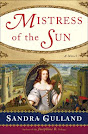
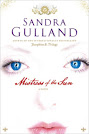
Iris, my editor and publisher, just emailed me that Mistress of the Sun was #1 on the Globe and Mail Historical Fiction list! She and Norma, the receptionist at HarperCollins Canada, "enjoyed the sight of it for several minutes," and then Norma pointed out that Under the Sun by Sandra Gulland was also on the list, further down. "We are mystified by this," Iris wrote, "an error on someone's part. But, you have to admit it's pretty nice to be in two places on one bestseller list."

I do indeed! I jokingly wrote back that if The Next Novel were titled Under the Sun it could be called a bestseller before it was even written, much less published.

Monday, June 1, 2009

Mothers and daughters at readings

.
.
I had a reading in the beautiful rural Ontario town of Uxbridge yesterday afternoon, as part of the Blue Heron Books "Books & Brunch" reading series. Shelley Macbeth of the bookstore did an outstanding job (yay, Indies!). My on-stage interview after the reading by Susanna Kearsley was very enjoyable. Her questions were interesting — in large part, I think, because she's an historical author herself. (See her books here.)

I heard some wonderful stories from fans. One woman told me that her husband threatened divorce if she read another book by "that Josephine woman" (because she disappeared into the books). Another young woman told me her boyfriend had the same complaint. One woman said she reread Josephine once a month!

There were a number of mother/daughter couples in attendance. Below, Kathryn and Emma, Teri and Margaret, and Judy and Eleanor. (My apologies if I do not have the names in the right order.)


Kathryn (top left) had a full set of the hard-cover first editions of the Trilogy -- very hard to find now. She'd gone to some trouble to find them and had them beautifully protected in plastic covers. I love those first books, and I get quite emotional seeing them all in a set like that and so clearly dearly loved.
image