.
.
I'm in the process of having all of my website and blogs changed over from Blogger to WordPress. I've been frustrated by Blogger for too long. The formatting can be so ungainly and uncontrollable!
But the main reason to change is that under WordPress, my entire website will be under my control: I won't have to hire a Net Guru to change a comma, for example.
That said, there are bound to be glitches and frustrations ahead, so please bear with me!

Saturday, November 6, 2010


Thursday, November 4, 2010
Cheers for the Josephine B. Team
.
.
I'm in that anxious holding pattern now, waiting for The Taskmaster's feedback. (Of course I always assume that he's unhappy with the work.) Not that there isn't a great deal to do:

On learning about Google Lit Trips, I threw out the idea of a Josephine B. Lit Trip to my readers on my Facebook page, and a number of them jumped at the challenge. They would do it! With the help of Jerome Burg, creator of Google Lit Trips, they put together the initial draft of a Lit Trip for The Many Lives & Secret Sorrows of Josephine B. It's likely that this is the first time Facebook fans have taken on a collaborative project like this, which I find thrilling.
However, The Taskmaster has been working me so hard, I'd not had a chance to give their work a close look...until now. And it's awesome! (Cheers for the Josephine B. team!)
It's also a little daunting because in some cases I need to try to find specific locations: where Josephine (then Rose) lived when she first came to Paris; the location of her aunt's county home; the church she was first married in. I have notes on my computer—from over 15 years ago!—but they are sketchy. However, in the time since the first Josephine B. was published in 1995, internet research has exploded. I'm amazed by what I'm able to discover now.
For one thing: I learned today that Josephine lived not far from where we stayed last spring in Paris, not far from where my current heroine lived. I had a general idea before, but Net research makes it possible to find out rather quickly the history of her street, its many transformations over time. Net research allows me to find out the exact address of Aunt Désirée's country home in Noisy-le-Grand, which, I confess, is grander than I'd imagined.

It all makes me just a bit dizzy!
*****
Website: http://www.sandragulland.com/
Blog: http://sandragulland.blogspot.com/
Facebook: http://bit.ly/sgullandFacebook
Twitter: http://twitter.com/Sandra_Gulland
Tumblr: http://sandragulland.tumblr.com/
.
I'm in that anxious holding pattern now, waiting for The Taskmaster's feedback. (Of course I always assume that he's unhappy with the work.) Not that there isn't a great deal to do:
Research, research, research.
Gather and organize my scattered revision notes.
Get back to the Google Lit Trip project for The Many Lives & Secret Sorrows of Josephine B.This last, the Google Lit Trip, is both exciting and exhausting. Google Lit Trips are an exciting educational tool: they allow students to geographically follow the course of a novel they are reading, as well as to explore, on-line, subjects that come up. For example, there's one for The Kite Runner:

On learning about Google Lit Trips, I threw out the idea of a Josephine B. Lit Trip to my readers on my Facebook page, and a number of them jumped at the challenge. They would do it! With the help of Jerome Burg, creator of Google Lit Trips, they put together the initial draft of a Lit Trip for The Many Lives & Secret Sorrows of Josephine B. It's likely that this is the first time Facebook fans have taken on a collaborative project like this, which I find thrilling.
However, The Taskmaster has been working me so hard, I'd not had a chance to give their work a close look...until now. And it's awesome! (Cheers for the Josephine B. team!)
It's also a little daunting because in some cases I need to try to find specific locations: where Josephine (then Rose) lived when she first came to Paris; the location of her aunt's county home; the church she was first married in. I have notes on my computer—from over 15 years ago!—but they are sketchy. However, in the time since the first Josephine B. was published in 1995, internet research has exploded. I'm amazed by what I'm able to discover now.
For one thing: I learned today that Josephine lived not far from where we stayed last spring in Paris, not far from where my current heroine lived. I had a general idea before, but Net research makes it possible to find out rather quickly the history of her street, its many transformations over time. Net research allows me to find out the exact address of Aunt Désirée's country home in Noisy-le-Grand, which, I confess, is grander than I'd imagined.
It all makes me just a bit dizzy!
*****
Website: http://www.sandragulland.com/
Blog: http://sandragulland.blogspot.com/
Facebook: http://bit.ly/sgullandFacebook
Twitter: http://twitter.com/Sandra_Gulland
Tumblr: http://sandragulland.tumblr.com/
Wednesday, November 3, 2010
Novel hypnosis
.
.
 I finished reading Room by Emma Donoghue last night. I can't recall a reading experience so intense: I didn't move—literally—for two and a half hours, not until I'd come to the end. And then I stumbled around for a bit, stunned.
The novel is told from the point-of-view of a five-year-old. I've read in an interview that Emma Donoghue studied the language patterns of her own five-year-old child to create the voice for this story. She profoundly succeeds, but what is her true accomplishment, in my view, is her ability to see (or appear to see) from the point-of-view of a child—a child born and raised in captivity.
Room has garnered a bouquet of raves from fine writers, such as this one from Michael Cunningham, author of The Hours:
As a writer, it reinforced, for me, the importance of the imagination, of imaginative penetration into the world of ones characters. The first enchantment must be the author's own.
*****
Website: http://www.sandragulland.com/
Blog: http://sandragulland.blogspot.com/
Facebook: http://bit.ly/sgullandFacebook
Twitter: http://twitter.com/Sandra_Gulland
Tumblr: http://sandragulland.tumblr.com/
.
The novel is told from the point-of-view of a five-year-old. I've read in an interview that Emma Donoghue studied the language patterns of her own five-year-old child to create the voice for this story. She profoundly succeeds, but what is her true accomplishment, in my view, is her ability to see (or appear to see) from the point-of-view of a child—a child born and raised in captivity.
Room has garnered a bouquet of raves from fine writers, such as this one from Michael Cunningham, author of The Hours:
"Room is that rarest of entities, an entirely original work of art. I mean it as the highest possible praise when I tell you that I can't compare it to any other book. Suffice to say that it's potent, darkly beautiful, and revelatory."I agree. It is also charming, as well as enchanting.
As a writer, it reinforced, for me, the importance of the imagination, of imaginative penetration into the world of ones characters. The first enchantment must be the author's own.
*****
Website: http://www.sandragulland.com/
Blog: http://sandragulland.blogspot.com/
Facebook: http://bit.ly/sgullandFacebook
Twitter: http://twitter.com/Sandra_Gulland
Tumblr: http://sandragulland.tumblr.com/
Sunday, October 31, 2010
Dress up as a book for Halloween
.
.
This quote from L.A. Times blog last year:
.
This quote from L.A. Times blog last year:
Interviewer: Your book "The Handmaid's Tale" has become a seminal feminist work taught in universities all over.
Atwood: You know you've really made it when people start dressing up like that on Halloween.I think a "You know you've really made it when..." blog might be amusing.
On rejection, or fear thereof
.
.
I may have mentioned this article before, but I found a reference to it in my computer files and feel it's worth mention:
.
I may have mentioned this article before, but I found a reference to it in my computer files and feel it's worth mention:
30 famous authors whose works were rejected (repeatedly, and sometimes rudely) by publishers — an article by Michelle Kerns for examiner.com.We all need to remember this.
Saturday, October 30, 2010
Laden with fear and doubt
.
.
You might have noticed the addition of tabs to this blog. One is for quotes, most often to do with writing. I've just added this one by Philip Roth:
I think a first draft is by nature exciting: so much is possible. But then comes the long, long middle—drafts two, three, four ... . These are so tough: fear and doubt indeed. The last draft is indeed satisfying; the words "the end" must surely be the most beautiful in the language.
On a personal note: we're now in San Miguel de Allende. I'm almost settled in. Soon I'll be getting back to work, laden with fear and doubt.
Sandra Gulland
*****
Website: http://www.sandragulland.com/
Blog: http://sandragulland.blogspot.com/
Facebook: http://bit.ly/sgullandFacebook
Twitter: http://twitter.com/Sandra_Gulland
Tumblr: http://sandragulland.tumblr.com/
.
You might have noticed the addition of tabs to this blog. One is for quotes, most often to do with writing. I've just added this one by Philip Roth:
“I find it arduous and un-doable. It’s laden with fear and doubt. It’s never easy—not for me. The ordeal is part of the task, and the satisfaction usually comes at the end. You stood up to it, you endured it! You achieved the unachievable—for you. But the next time out, I find it impossible all over again.” —Philip Roth, as quoted in Vanity Fair, November 2010.(It goes to show what riches await in the magazine stack at the beauty parlour.)
I think a first draft is by nature exciting: so much is possible. But then comes the long, long middle—drafts two, three, four ... . These are so tough: fear and doubt indeed. The last draft is indeed satisfying; the words "the end" must surely be the most beautiful in the language.
On a personal note: we're now in San Miguel de Allende. I'm almost settled in. Soon I'll be getting back to work, laden with fear and doubt.
Sandra Gulland
*****
Website: http://www.sandragulland.com/
Blog: http://sandragulland.blogspot.com/
Facebook: http://bit.ly/sgullandFacebook
Twitter: http://twitter.com/Sandra_Gulland
Tumblr: http://sandragulland.tumblr.com/
Tuesday, October 26, 2010
Ask and ye shall find
.
.
Doug De La Matter, a reader of this blog, sent me the answer to my question: Who painted the image I pin in front of my computer—an image I find profoundly evocative of the creative process? (See my post below.)
The artist, it turns out, is Evariste Vital Luminais, from Nantes, France (1821-1896), and the name of the painting is "Enervés Jumièges," which refers to an ancient and tragic legend about the sons of Clovis II.
Frankly, I don't really want to know what the painting represents because I've created my own story around it. What I do find quite interesting, however, is the evolution of the work.
The first draft
The first study for the painting is, I've read, of torture. (No! Don't tell me that.)


.
Doug De La Matter, a reader of this blog, sent me the answer to my question: Who painted the image I pin in front of my computer—an image I find profoundly evocative of the creative process? (See my post below.)
The artist, it turns out, is Evariste Vital Luminais, from Nantes, France (1821-1896), and the name of the painting is "Enervés Jumièges," which refers to an ancient and tragic legend about the sons of Clovis II.
Frankly, I don't really want to know what the painting represents because I've created my own story around it. What I do find quite interesting, however, is the evolution of the work.
The first draft
The first study for the painting is, I've read, of torture. (No! Don't tell me that.)

The second draft
Second image shows a boy grieving:

The final
There are two versions of the final. The first, "The Sons of Clovis II," has a hopeless, leaden quality ...

... quite different from the second, which is the one that "speaks" to me. In this one I like the way the man on the left stares into space in such a focussed way. I like to think he's on the edge of waking, thinking ... thinking ... .

For more on these evocative paintings, see this article on Wikipedia. For more on the work of Evariste Vital Luminais, click here.
Thank you, Doug! He revealed that he was able to solve the mystery by posting the image on LinkedIn Questions and within 10 minutes was directed to images on tineye.com. Another person supplied a translation of a Wiki entry. All of which proves how incredible powerful Net research can be.
A note on TinEye.com: this is an amazing search engine. You can upload an image, and it will tell you where else it is on the Net. Artists use it to make sure that their work isn't being used without permission, but I will find it useful, I'm sure, to track down the name and artist of an image.
A note on TinEye.com: this is an amazing search engine. You can upload an image, and it will tell you where else it is on the Net. Artists use it to make sure that their work isn't being used without permission, but I will find it useful, I'm sure, to track down the name and artist of an image.
Sandra Gulland
*****
Website: http://www.sandragulland.com/
Blog: http://sandragulland.blogspot.com/
Facebook: http://bit.ly/sgullandFacebook
Twitter: http://twitter.com/Sandra_Gulland
Tumblr: http://sandragulland.tumblr.com/
Sunday, October 24, 2010
Good-bye Bunker
.
Today is my last day in my northern office—affectionately called The Bunker. I love the office I'll be moving to in San Miguel de Allende, Mexico, but my Bunker in rural Ontario, overlooking fields and a maple forest, is my favourite writing space, and it's always hard to leave. Not only is it lovely and cosy and quiet, but this is where my books are, this is the core of my research library.
Your home is where your books are, someone said, and I believe that to be true.
 Books everywhere!
Right now, the desk in the photo is covered with stacks of books: books to be considered, books without a place on my shelves. (Another problem, that!) Which books should I take with me? What research books am I going to need in the six months ahead? This is not a question that can be answered easily ... at least not by me.
With so little time left, I'll aim to simply tidy today, leaving post-it notes on all the various piles.
I can't take my bulletin board, alas
On the wall in front of the desk I have a framed print, a bulletin board and a Edward Gorey calendar. The bulletin board has inspiring images and quotes on it: "Want • Obstacle • Action," for example.
Images of creativity
Two of the images on the bulletin board are especially dear to me. One, of men carving up blocks of stone, is evocative of the heavy lifting of the revision process.

The other image is one I haven't been able to identify. (If you can identify it, I'd be eternally grateful!) It's of two people, possibly a man and a woman, floating on a platform on a lake, half-emmersed in water. This image captures, for me, the feeling of the creative process, of immersion in unconscious.

The two images—one evocative of the unconscious, the other of the conscious, I think—work together in any act of creation.
Should I take my Edward Gorey calendar? I've loved it so! No: I'll fast-forward through November and December, and in the Spring, on return, I'll put it in my keeper box. Ironically, I just peeked at the caption for November:
Floating image: unknown to me. If you know, please write.
Sandra Gulland
*****
Website: http://www.sandragulland.com/
Blog: http://sandragulland.blogspot.com/
Facebook: http://bit.ly/sgullandFacebook
Twitter: http://twitter.com/Sandra_Gulland
Tumblr: http://sandragulland.tumblr.com/
Today is my last day in my northern office—affectionately called The Bunker. I love the office I'll be moving to in San Miguel de Allende, Mexico, but my Bunker in rural Ontario, overlooking fields and a maple forest, is my favourite writing space, and it's always hard to leave. Not only is it lovely and cosy and quiet, but this is where my books are, this is the core of my research library.
Your home is where your books are, someone said, and I believe that to be true.

Right now, the desk in the photo is covered with stacks of books: books to be considered, books without a place on my shelves. (Another problem, that!) Which books should I take with me? What research books am I going to need in the six months ahead? This is not a question that can be answered easily ... at least not by me.
With so little time left, I'll aim to simply tidy today, leaving post-it notes on all the various piles.
I can't take my bulletin board, alas
On the wall in front of the desk I have a framed print, a bulletin board and a Edward Gorey calendar. The bulletin board has inspiring images and quotes on it: "Want • Obstacle • Action," for example.
Images of creativity
Two of the images on the bulletin board are especially dear to me. One, of men carving up blocks of stone, is evocative of the heavy lifting of the revision process.

The other image is one I haven't been able to identify. (If you can identify it, I'd be eternally grateful!) It's of two people, possibly a man and a woman, floating on a platform on a lake, half-emmersed in water. This image captures, for me, the feeling of the creative process, of immersion in unconscious.

The two images—one evocative of the unconscious, the other of the conscious, I think—work together in any act of creation.
Should I take my Edward Gorey calendar? I've loved it so! No: I'll fast-forward through November and December, and in the Spring, on return, I'll put it in my keeper box. Ironically, I just peeked at the caption for November:
It would carry off objects of which it grew fond,
And protect them by dropping them into the pond.Construction image: Granite for monuments (for future monuments), 1939. Lithograph by Louis Lozowick.
Floating image: unknown to me. If you know, please write.
Sandra Gulland
*****
Website: http://www.sandragulland.com/
Blog: http://sandragulland.blogspot.com/
Facebook: http://bit.ly/sgullandFacebook
Twitter: http://twitter.com/Sandra_Gulland
Tumblr: http://sandragulland.tumblr.com/
Tuesday, October 12, 2010
What's holding you back?
.
This article—"What's holding you back?"—was written for academics, but the suggestions are excellent for any writer. For me, achievable daily goals are key: goals I try to meet before allowing the rest of my To Do list to topple me.
*****
Website: http://www.sandragulland.com/
Blog: http://sandragulland.blogspot.com/
Facebook: http://bit.ly/sgullandFacebook
Twitter: http://twitter.com/Sandra_Gulland
Tumblr: http://sandragulland.tumblr.com/
This article—"What's holding you back?"—was written for academics, but the suggestions are excellent for any writer. For me, achievable daily goals are key: goals I try to meet before allowing the rest of my To Do list to topple me.
*****
Website: http://www.sandragulland.com/
Blog: http://sandragulland.blogspot.com/
Facebook: http://bit.ly/sgullandFacebook
Twitter: http://twitter.com/Sandra_Gulland
Tumblr: http://sandragulland.tumblr.com/
Friday, October 1, 2010
The visual dimension: tips from film-makers
.
.
Before I begin my writing day, before my mug of decaf cools, I check my email, Twitter, a few websites. Today this blog by Alexandra Sokoloff on visual storytelling resonated, especially with respect to rewriting.
I am in a slow, difficult crawl through my third draft. This is the draft that (to paraphrase Kingsolver), "brings the meaning up and turns on the lights." I have to fill out the visual dimension—which, for me, requires quite a bit of research.
Read the Alexandra Sokoloff blog. I like her film-making suggestions for thinking in terms of "establishing shots" and "master shots." Approaching a Big Scene is intimidating. I'll see if it helps to mentally put myself behind a camera.
.
Before I begin my writing day, before my mug of decaf cools, I check my email, Twitter, a few websites. Today this blog by Alexandra Sokoloff on visual storytelling resonated, especially with respect to rewriting.
I am in a slow, difficult crawl through my third draft. This is the draft that (to paraphrase Kingsolver), "brings the meaning up and turns on the lights." I have to fill out the visual dimension—which, for me, requires quite a bit of research.
Read the Alexandra Sokoloff blog. I like her film-making suggestions for thinking in terms of "establishing shots" and "master shots." Approaching a Big Scene is intimidating. I'll see if it helps to mentally put myself behind a camera.
*****
Website: http://www.sandragulland.com/
Blog: http://sandragulland.blogspot.com/
Facebook: http://bit.ly/sgullandFacebook
Twitter: http://twitter.com/Sandra_Gulland
Tumblr: http://sandragulland.tumblr.com/
Website: http://www.sandragulland.com/
Blog: http://sandragulland.blogspot.com/
Facebook: http://bit.ly/sgullandFacebook
Twitter: http://twitter.com/Sandra_Gulland
Tumblr: http://sandragulland.tumblr.com/
Wednesday, September 29, 2010
Joyce Carol Oates on creating character
.
.
This is excellent (thank you, DeAnna Cameron):
*****
Website: http://www.sandragulland.com/
Blog: http://sandragulland.blogspot.com/
Facebook: http://bit.ly/sgullandFacebook
Twitter: http://twitter.com/Sandra_Gulland
Tumblr: http://sandragulland.tumblr.com/
.
This is excellent (thank you, DeAnna Cameron):
*****
Website: http://www.sandragulland.com/
Blog: http://sandragulland.blogspot.com/
Facebook: http://bit.ly/sgullandFacebook
Twitter: http://twitter.com/Sandra_Gulland
Tumblr: http://sandragulland.tumblr.com/
Tuesday, September 28, 2010
How close are you to your character?
.
.
I'm putting away my notes from the Kingston WritersFest, and I think the one big message I got, in both Joan Thomas's workshop on narrative voice and point-of-view and Michael Winter's on "found fiction," had to do with narrative distance.
Thomas asked: How intimate is your stance with respect to the character?
Winter talked about the importance of changing that space: closing in, backing up, closing in again.
When writing from the 1st person, that distance would seem to be fixed—although the character's degree of self-revelation would vary.
Right now I'm writing from a close 3rd person point-of-view (that is, I'm always with my main character), and I've been wondering how to interpret this concept of narrative distance. Sometimes I show my character focussed on what is going on around her, and at other times, I show her lost in the swirl of her emotions. So, in a way, when writing in the 1st person or close 3rd, the narrative distance is within the character.
This is the type of thing writers love to talk about. Put two writers together for 10 minutes and the subject of point-of-view is sure to come up. At one point in Kingston, I was in a packed elevator—we were strangers, in fact—and from the 5th to the ground floor, the talk was of point-of-view. Writers!
*****
Website: http://www.sandragulland.com/
Blog: http://sandragulland.blogspot.com/
Facebook: http://bit.ly/sgullandFacebook
Twitter: http://twitter.com/Sandra_Gulland
Tumblr: http://sandragulland.tumblr.com/
.
I'm putting away my notes from the Kingston WritersFest, and I think the one big message I got, in both Joan Thomas's workshop on narrative voice and point-of-view and Michael Winter's on "found fiction," had to do with narrative distance.
Thomas asked: How intimate is your stance with respect to the character?
Winter talked about the importance of changing that space: closing in, backing up, closing in again.
When writing from the 1st person, that distance would seem to be fixed—although the character's degree of self-revelation would vary.
Right now I'm writing from a close 3rd person point-of-view (that is, I'm always with my main character), and I've been wondering how to interpret this concept of narrative distance. Sometimes I show my character focussed on what is going on around her, and at other times, I show her lost in the swirl of her emotions. So, in a way, when writing in the 1st person or close 3rd, the narrative distance is within the character.
This is the type of thing writers love to talk about. Put two writers together for 10 minutes and the subject of point-of-view is sure to come up. At one point in Kingston, I was in a packed elevator—we were strangers, in fact—and from the 5th to the ground floor, the talk was of point-of-view. Writers!
*****
Website: http://www.sandragulland.com/
Blog: http://sandragulland.blogspot.com/
Facebook: http://bit.ly/sgullandFacebook
Twitter: http://twitter.com/Sandra_Gulland
Tumblr: http://sandragulland.tumblr.com/
Monday, September 27, 2010
Leaving, returning
.
.
Stepping into my writing room this morning after four days away, I wished I had left it tidy. There is hardly room for my mug of decaf midst the festering mounds of post-it notes and scraps.
It's always hard to return to writing after time away. Of course I had intended to write while at the Kingston WritersFest; of course that was impossible!
Later today, after I emerge from my writing room into that vast demanding arena called Life, I intend to gather my learnings and post them here. But now it's time to dive back in...or at least dip in a toe.
Leaving the Festival hotel, a volunteer called out, "We love you, keep writing!" I'm a writer; I should be able to express in some fresh way how moving that was to hear. Instead I'll just say that I'm tempted to print that out in bold and post it to my bulletin board.
Yes, I'll do that, and then I'll put my toe in, check to see how cold the water feels.
.
Stepping into my writing room this morning after four days away, I wished I had left it tidy. There is hardly room for my mug of decaf midst the festering mounds of post-it notes and scraps.
It's always hard to return to writing after time away. Of course I had intended to write while at the Kingston WritersFest; of course that was impossible!
Later today, after I emerge from my writing room into that vast demanding arena called Life, I intend to gather my learnings and post them here. But now it's time to dive back in...or at least dip in a toe.
Leaving the Festival hotel, a volunteer called out, "We love you, keep writing!" I'm a writer; I should be able to express in some fresh way how moving that was to hear. Instead I'll just say that I'm tempted to print that out in bold and post it to my bulletin board.
Yes, I'll do that, and then I'll put my toe in, check to see how cold the water feels.
Saturday, September 25, 2010
Returning to where it all began
.
.
Returning to Kingston, Ontario, is always special for me. When I first decided that I was going to write, be a writer—go for it—I began by attending a workshop here. That was about 25 years ago.
Returning to Kingston always brings back memories of that long-ago self, memories of my longing to be a writer; of walking along the shoreline, lost in thought; memories of my flying elation over my instructor's encouragement. Memories of attending the inspiring readings given by writers — writers I regarded with awe, writers who are now my good friends.
Each time I return, I add another layer of experience. For two years I've been coming to the Kingston WritersFest.
Yesterday I had the pleasure of meeting Joan Thomas, whose book Curiosity I mentioned earlier in this blog (a novel now long-listed for the Giller!). Her workshop on narrative voice and point-of-view has me thinking, considering loosening the fixed "narrative distance" I've imposed on the novel I'm writing now.
Last night, Jane Urquhart interviewed Joyce Carol Oates on-stage. Oates had finished a novel and 1:00 that morning. She said that for months it had felt like crawling across a floor pushing a peanut with my nose. That, believe me, resonated!
*****
Website: http://www.sandragulland.com/
Blog: http://sandragulland.blogspot.com/
Facebook: http://bit.ly/sgullandFacebook
Twitter: http://twitter.com/Sandra_Gulland
Tumblr: http://sandragulland.tumblr.com/
.
Returning to Kingston, Ontario, is always special for me. When I first decided that I was going to write, be a writer—go for it—I began by attending a workshop here. That was about 25 years ago.
Returning to Kingston always brings back memories of that long-ago self, memories of my longing to be a writer; of walking along the shoreline, lost in thought; memories of my flying elation over my instructor's encouragement. Memories of attending the inspiring readings given by writers — writers I regarded with awe, writers who are now my good friends.
Each time I return, I add another layer of experience. For two years I've been coming to the Kingston WritersFest.
Yesterday I had the pleasure of meeting Joan Thomas, whose book Curiosity I mentioned earlier in this blog (a novel now long-listed for the Giller!). Her workshop on narrative voice and point-of-view has me thinking, considering loosening the fixed "narrative distance" I've imposed on the novel I'm writing now.
Last night, Jane Urquhart interviewed Joyce Carol Oates on-stage. Oates had finished a novel and 1:00 that morning. She said that for months it had felt like crawling across a floor pushing a peanut with my nose. That, believe me, resonated!
*****
Website: http://www.sandragulland.com/
Blog: http://sandragulland.blogspot.com/
Facebook: http://bit.ly/sgullandFacebook
Twitter: http://twitter.com/Sandra_Gulland
Tumblr: http://sandragulland.tumblr.com/
Monday, September 20, 2010
Construction site revision
.

Years ago, I came upon a slender little book titled My Editor, by M.B. Goffstein. It's a poem of few lines, with simple, geometric illustrations, describing the process of working with an editor on revision.
I loved it so much I bought three, thinking of people I knew who might love it too. Now I only have one.
I've been thinking of it a lot, of late, going though the revision of The Next Novel, working with The Taskmaster (editor). The poem evokes the rewriting process as a construction site:
*****
Website: http://www.sandragulland.com/
Blog: http://sandragulland.blogspot.com/
Facebook: http://bit.ly/sgullandFacebook
Twitter: http://twitter.com/Sandra_Gulland
Tumblr: http://sandragulland.tumblr.com/

Years ago, I came upon a slender little book titled My Editor, by M.B. Goffstein. It's a poem of few lines, with simple, geometric illustrations, describing the process of working with an editor on revision.
I loved it so much I bought three, thinking of people I knew who might love it too. Now I only have one.
I've been thinking of it a lot, of late, going though the revision of The Next Novel, working with The Taskmaster (editor). The poem evokes the rewriting process as a construction site:
I begin to dig again, and lose myself in the excavation.Of course the new creation isn't quite right at first, and his editor sends him back to revise.
... my building worries me. It's stone cold, and I cry, "Why not have left it wobbly?"There is a feeling of integrity in the early drafts that is initially lost in revising, until, with time, a new integrity emerges.
Take it apart, and suddenly see how it goes.This book is a treasure, and greatly heartening.
*****
Website: http://www.sandragulland.com/
Blog: http://sandragulland.blogspot.com/
Facebook: http://bit.ly/sgullandFacebook
Twitter: http://twitter.com/Sandra_Gulland
Tumblr: http://sandragulland.tumblr.com/
Sunday, September 19, 2010
Friday, September 17, 2010
Research overload
.
.
It's fall, and time for me to begin thinking of what research books I'm going to take south with me this winter. What am I going to need as I continue work on The Next Novel?
The technology changes so quickly, my database and library systems have radically changed. Now I note which books are searchable on Amazon.com and which on Books Google. Other books are fully on-line or downloaded onto my computer.
I've a towering stack of books that I've already read and marked with notes. I'm considering photographing the pages: put into EverNote (or DevonThink, possibly?), they would then be searchable. I could scan, but that takes longer.
My luggage lightens, and my computer swells. And as for my head? It's about to explode!
*****
Website: http://www.sandragulland.com/
Blog: http://sandragulland.blogspot.com/
Facebook: http://bit.ly/sgullandFacebook
Twitter: http://twitter.com/Sandra_Gulland
Tumblr: http://sandragulland.tumblr.com
.
It's fall, and time for me to begin thinking of what research books I'm going to take south with me this winter. What am I going to need as I continue work on The Next Novel?
The technology changes so quickly, my database and library systems have radically changed. Now I note which books are searchable on Amazon.com and which on Books Google. Other books are fully on-line or downloaded onto my computer.
I've a towering stack of books that I've already read and marked with notes. I'm considering photographing the pages: put into EverNote (or DevonThink, possibly?), they would then be searchable. I could scan, but that takes longer.
My luggage lightens, and my computer swells. And as for my head? It's about to explode!
*****
Website: http://www.sandragulland.com/
Blog: http://sandragulland.blogspot.com/
Facebook: http://bit.ly/sgullandFacebook
Twitter: http://twitter.com/Sandra_Gulland
Tumblr: http://sandragulland.tumblr.com
Sunday, August 29, 2010
A Revision Rule-of-Thumb
.
In A Writer's Time (a book I recommend), the author Kenneth Atchity describes the state called End Time, when the work at hand is approaching finish. He says:
It's a technique I recommend.
Key to The Taskmaster's technique, as well, is to ask for a slow-motion rewriting of the opening chapters: set the scene, properly introduce the characters, the themes.
In practical terms, for me, it has meant doubling the first 40 or so pages of my manuscript, and doing the same again for the opening of Part Two, where there is huge leap in time and place.
I'd venture to guess that it could be a revision rule-of-thumb: double the first 80 pages of your second draft.
Today I'm in post-End-Time euphoria, the glow that comes with the magical words, The End.
For now ....
In A Writer's Time (a book I recommend), the author Kenneth Atchity describes the state called End Time, when the work at hand is approaching finish. He says:
"End Time is characterized by high energy flow and pressure to finish. ... Think of the slow-moving horse, after an exhausting day in the field, who hears the whistle and gallops at high speed for the barn. ... Lock yourself up if necessary, turn off the phone, leave home, anything to allow End Time its way once you're sure its way can lead to the end."The Taskmaster (the editor I'm working with now) is cleverly feeding me only three or four chapters at a time to revise. Each section must be right before we move on. With each chunk, I go through all the phases of completing an entire novel, including the exhaustion of End Time.
It's a technique I recommend.
Key to The Taskmaster's technique, as well, is to ask for a slow-motion rewriting of the opening chapters: set the scene, properly introduce the characters, the themes.
In practical terms, for me, it has meant doubling the first 40 or so pages of my manuscript, and doing the same again for the opening of Part Two, where there is huge leap in time and place.
I'd venture to guess that it could be a revision rule-of-thumb: double the first 80 pages of your second draft.
Today I'm in post-End-Time euphoria, the glow that comes with the magical words, The End.
For now ....
Thursday, August 26, 2010
Time management for authors
.
.
I love InkyGirl cartoons:

This is, alas, too true! I start my day with a mug of coffee and the Social Net. Then: to work.
.
I love InkyGirl cartoons:

This is, alas, too true! I start my day with a mug of coffee and the Social Net. Then: to work.
Sunday, August 22, 2010
Novelists: a magpie mind
.
.
I love Sunday mornings with the Ottawa Citizen's wonderful book pages.
This morning I very much enjoyed an interview of David Mitchell, author of Cloud Atlas and, newly-out, The Thousand Autumns of Jacob de Zoet. Here are the passages I highlighted:
I was thinking the other day about a South American author who said, "I'm a writer. Of course I steal." (If anyone knows the name of this author, I'd love to give him credit.) I am incapable of making things up: I have to find each nugget, each tiny detail. Magpie mind indeed.
On the process of writing, Mitchell said: "It's making something that isn't working work. It's like fixing an engine."
And so, with that, I'll head back into the machine shop ... .
.
I love Sunday mornings with the Ottawa Citizen's wonderful book pages.
This morning I very much enjoyed an interview of David Mitchell, author of Cloud Atlas and, newly-out, The Thousand Autumns of Jacob de Zoet. Here are the passages I highlighted:
"Sometimes I try to write a scene, sometimes a sentence, and I can't get to the end of it without half a morning's research."I often fall into what I call "The Black Hole" of research when writing, and Mitchell's statement makes me feel better about what I sometimes think is a diversion.
"Novelists ... require a magpie mind."I love this.
I was thinking the other day about a South American author who said, "I'm a writer. Of course I steal." (If anyone knows the name of this author, I'd love to give him credit.) I am incapable of making things up: I have to find each nugget, each tiny detail. Magpie mind indeed.
On the process of writing, Mitchell said: "It's making something that isn't working work. It's like fixing an engine."
And so, with that, I'll head back into the machine shop ... .
Wednesday, August 18, 2010
A beautiful cover!
.
.
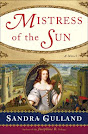
I'm thrilled with the Talpress Czech edition of Mistress of the Sun. It's gorgeous, ribbon bookmark and everything!

.
I'm thrilled with the Talpress Czech edition of Mistress of the Sun. It's gorgeous, ribbon bookmark and everything!

Monday, August 9, 2010
In praise of ugly ducklings
.
I've hit that patch of despond every writer knows:
 When not writing (that is, wrestling), I've been compulsively reading a wonderful novel: The Lovers by Vendela Vida. It's a short, elegant, emotionally gripping story.
And word perfect — the sort of novel that makes any writer envious. In my present mood, I was flushed with a feeling of awe mixed with inadequacy, and so it was with relief that I read in the acknowledgement the author's long list of readers who had helped the novel through "its early and inelegant forms."
This is a beautiful novel, and I find it perversely reassuring to know that it, too, was once an ugly duckling.
I've been having a beastly time with the chapters I'm working on now. My characters are not speaking to me. That's a writerly, romantic way of saying I've lost contact with them, I'm not seeing them.
I've hit that patch of despond every writer knows:
"I should give up writing."
"I'm no good at this."

And word perfect — the sort of novel that makes any writer envious. In my present mood, I was flushed with a feeling of awe mixed with inadequacy, and so it was with relief that I read in the acknowledgement the author's long list of readers who had helped the novel through "its early and inelegant forms."
This is a beautiful novel, and I find it perversely reassuring to know that it, too, was once an ugly duckling.
Saturday, August 7, 2010
Lost and found in revision
.
.
This morning, braced by a good sleep, I went through my manuscript scene by scene, listing the changes I would have to make were I to change the Mortemart mansion to the left bank, where I now believe it did exist. (See my early post: here.)
And decided: I would make the move.
Making the decision is half the battle. Making the changes will be painful, but I like the security of place, the foundation of fact. Plus, there's an excellent floor plan: how delicious.
To see my findings, a map and the floor plan: click here.
.
This morning, braced by a good sleep, I went through my manuscript scene by scene, listing the changes I would have to make were I to change the Mortemart mansion to the left bank, where I now believe it did exist. (See my early post: here.)
And decided: I would make the move.
Making the decision is half the battle. Making the changes will be painful, but I like the security of place, the foundation of fact. Plus, there's an excellent floor plan: how delicious.
To see my findings, a map and the floor plan: click here.
Friday, August 6, 2010
The problem writing with fact-based fiction
.
.
The problem with writing fact-based fiction is ... well ... facts. They can really mess up a good story.
I'd read that the Mortemarts, the family of Athénaïs, Madame de Montespan, lived on rue de Rosiers.
Perfect: rue des Rosiers is not far from where Claude des Oeillets, my main character, lived when she first came to Paris. It worked into the story perfectly. Their lives do become entwined; nobody knows how their relationship began, but as a novelist it helped that they were walking distance from one another.
Twice I scouted rue de Rosiers on research trips to Paris. I took many photos, but more than that: I walked the cobbles, dreaming.
Unfortunately, I didn't read the fine print at the back of one of the texts. Hôtel Mortemart was on another rue de Rosiers, a street that is now named rue Saint-Guillaume ... far, far from my heroine Claude.
And that's not entirely certain, either. Some accounts claim that Hôtel Mortemart on rue Saint-Guillaume was built in 1663—three years after the young women meet.
So where were the Mortemarts living in 1660?
I've spent all morning researching possibilities (when I should have been writing). Vivonne, the eldest child, was born in the Tuileries palace. Both high-ranking parents served the King and Queen for three months of the year, and were likely entitled to live there ... so that's a possibility, although they certainly would have had a residence of their own in Paris.
I'm not really sure what I'm going to do about this. I could leave the setting as it is and make a note about the change in the Author's Note or on my website.
Or I could change it, place the Mortemarts either in the Tuileries or on rue Saint-Guillaume ... difficult, and not necessarily good for the story.
I'm still perplexed.
.
The problem with writing fact-based fiction is ... well ... facts. They can really mess up a good story.
I'd read that the Mortemarts, the family of Athénaïs, Madame de Montespan, lived on rue de Rosiers.
Perfect: rue des Rosiers is not far from where Claude des Oeillets, my main character, lived when she first came to Paris. It worked into the story perfectly. Their lives do become entwined; nobody knows how their relationship began, but as a novelist it helped that they were walking distance from one another.
Twice I scouted rue de Rosiers on research trips to Paris. I took many photos, but more than that: I walked the cobbles, dreaming.
Unfortunately, I didn't read the fine print at the back of one of the texts. Hôtel Mortemart was on another rue de Rosiers, a street that is now named rue Saint-Guillaume ... far, far from my heroine Claude.
And that's not entirely certain, either. Some accounts claim that Hôtel Mortemart on rue Saint-Guillaume was built in 1663—three years after the young women meet.
So where were the Mortemarts living in 1660?
I've spent all morning researching possibilities (when I should have been writing). Vivonne, the eldest child, was born in the Tuileries palace. Both high-ranking parents served the King and Queen for three months of the year, and were likely entitled to live there ... so that's a possibility, although they certainly would have had a residence of their own in Paris.
I'm not really sure what I'm going to do about this. I could leave the setting as it is and make a note about the change in the Author's Note or on my website.
Or I could change it, place the Mortemarts either in the Tuileries or on rue Saint-Guillaume ... difficult, and not necessarily good for the story.
I'm still perplexed.
Tuesday, August 3, 2010
Beginning, again and again
.
.
Editor Dan, who I will now refer to as The Taskmaster, is taking me through the manuscript revision slowly. The first 40 pages became 100. Now I've only 20 pages to work on—the first chapters of Part II—but it feels like looking up at Mount Everest.
I keep thinking: non-fiction would be so much easier. Easier to describe the dead than to try to bring them back to life.
Once again, I'm somewhat at a loss where to begin, how to begin. One consolation of experience is that I know that once I do, I will feel much more at ease.
Temptation: coffee. I must resist (I've given up caffeine); I'll console myself with breakfast popcorn, the perfect anxiety snack.
.
Editor Dan, who I will now refer to as The Taskmaster, is taking me through the manuscript revision slowly. The first 40 pages became 100. Now I've only 20 pages to work on—the first chapters of Part II—but it feels like looking up at Mount Everest.
I keep thinking: non-fiction would be so much easier. Easier to describe the dead than to try to bring them back to life.
Once again, I'm somewhat at a loss where to begin, how to begin. One consolation of experience is that I know that once I do, I will feel much more at ease.
Temptation: coffee. I must resist (I've given up caffeine); I'll console myself with breakfast popcorn, the perfect anxiety snack.
Subscribe to:
Posts (Atom)


 Posts
Posts