Notes on the Writing Life

Notes on the Writing Life

Notes on the Writing Life

Sunday, June 28, 2009

More from "Immediate Fiction"

. .
Jerry Cleaver, author of Immediate Fiction, notes emphatically that emotion defines a character:
Who does she love & hate?
How does she love & hate?
It's in this realm of emotion that I'm most withholding in my fiction. It has to be dragged out of me every time! This time, I'm going to try to overdo it, at least at the start.

This quote from Immediate Fiction is spot on:
If you go too far out with your story, you can always cut back. An old writing rule says: The best way to find out what's enough is to do too much.
I need to keep this in mind this summer while writing the first draft. No brakes!

Thursday, June 25, 2009

On rewriting: did you know ... ?

.
.
I was surprised to learn in Cleaver's Immediate Fiction that John Fowles, author of The Collector and The French Lieutenant's Woman, rewrote The Magus ten years after it had been published to great success. There are two versions of The Magus in print, apparently: an astonishing thing. The second version was a best-seller as well.

I can well understand thinking about how a story might have been written, but can't imagine going back, not after it has been published.

Wednesday, June 24, 2009

Want/obstacle/action

.
.
Yesterday I finished the outline — or "blueprint" — of The End of Magic, working title of The Next Novel. Sixty pages! (Although there is lots of white space.) Twenty drafts! (Although many of these involved minor changes.)

Now it's time to move back to our country home and get to work. I've allowed myself four months to write the first draft.

One of the things I've enjoyed about our two-month stay in Toronto is use of the Toronto Public Library system. It's so easy to request a book on-line, so easy to pick it up. Jennifer Glossip, a wonderful fiction editor I've known for decades, shared with me the list of good books on fiction she gives out at workshops. A number of these titles were my favorites, as well, but several I hadn't heard of ... and so I've been having a look at some of them.

The one book that I gobbled up, covering it with post-it notes, was Immediate Fiction by Jerry Cleaver. It had an immediate impact on my outline. What do my characters want? What is the obstacle? What action results?
Want/obstacle/action ...
These need to be evident on every page.

What I love about reading a book like this is that it sets off ideas, sparking like mad. I'll be posting more about this book in days to come.

Saturday, June 13, 2009

R.I.P. Readerville.com

Readerville.com has been an important on-line community for me for a very, very long time. It came as a shock to me when it folded. I've made lasting friendships there, so in that respect it lives on.

What also lives on is the wonderful Readerville Journal. It's invariable captivating. For example, an article noting a wonderful blog, How books got their titles (http://garydexter.blogspot.com/). Ever wonder why The Medium is the Massage isn't The Medium is the Message?
Massage? Shouldn’t that be ‘message’? Well, yes, it should. When the book came back from the typesetter there was a misprint in the title. According to his son Eric, McLuhan took one look at it and exclaimed, ‘Leave it alone! It's great, and right on target!’.
This is an amazing blog. The author, Gary Dexter, is quite a researcher. "Why not Catch 21?" How can one resist?
One of the things I loved about Readerville.com is that I learned so much: the same goes for Readerville Journal. Bravo!

Thursday, June 11, 2009

101 Habits (last installment): On showing up at the office

.
.
The most lasting "habit" I think I'll keep for myself from The 101 Habits of Highly Successful Screenwriters has to do with how I think of my work.

At some point — I can't find the spot — one of the writers said that writing is scary, and that it helps temper the fear by thinking that you're doing it for money. I think there is something in that.

The other suggestion that I'm going to keep in mind is that when I finish the first draft of The Next Novel, I could work on another project. I could go back to puzzling over the plot of my abandoned novel on La Grande Mademoiselle, or develop any number of other stories that I would love to write. It's important to put a draft aside for a long period of time, but that doesn't mean everything comes to a halt.

Another screenwriter advised thinking of your writing as a corporation: you're expected to show up and get to work. These practical thoughts have stayed with me. Lately, I've been telling myself, "I had a good day at the office today." Or, "I have to get back to the office."

So: if I'm not here, it's because I'm at the office.

Tuesday, June 9, 2009

101 Habits (continued): on character

.
.
On character:
"Another reason why scripts fail is that the lead character's need, motivation, or goal is often not clear. You have to know what they want, no matter what it is or how goofy it is. And if you don't care about what they want, you won't be emotionally invested in the character." [Amy Holden Jones, page 124]
This type of question always makes me wonder: what does my character want? I think she wants out of poverty, out of the incessant struggle for survival. I think she longs frivolity and impractical gew-gaws. I just now realized this.

On raising the stakes:
You want the stakes, as the hero perceives them, to be as high as possible. ... You want your characters to be at risk and have things of great importance to them to be at stake. [Michael Schiffer, page 135]
I immediately made a change to my outline after reading this.

Wednesday, June 3, 2009

The 101 Habits of Highly Successful Screenwriters, part II

.
.
I've finished reading The 101 Habits of Highly Successful Screenwriters: I got a lot out of it. I'd love to see such a book on highly successful novelists, but in spite of the differences between novelists and screenwriters, there is a lot to be learned here.

I love this quote on procrastinating:
"I know when I'm about to write when I become a neat freak and start rearranging the pens and pencils around ... " [Steven DeSouza, page 95]
There was quite a bit on outlining before writing, which supports the process I'm using now.
"I try to build the story as cleanly as I can, make sure the structure works, then I write it really badly, as fast as I can ... " [Akiva Goldsman, page 107]
This same scriptwriter also had this to say:
"Unfortunately, people believe that their first thing should be great. Writing is like anything else. You're not supposed to write a page and expect it to be good. You have to write a thousand bad pages to get to that one good page." [Akiva Goldsman, page 123]
I feel that with the first two (unpublished) novels I wrote I didn't understand that one, two or even three drafts were not enough. Often, beginning writers don't give themselves enough time.
"The reality is that in order to be good at it, it will probably take you as long as any other profession to master the craft." [Michael Schiffer, page 125]
More tomorrow ...

Tuesday, June 2, 2009

One book, two spots on bestseller list! The plot thickens.

.
.
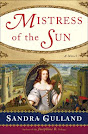
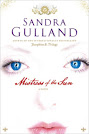
Iris, my editor and publisher, just emailed me that Mistress of the Sun was #1 on the Globe and Mail Historical Fiction list! She and Norma, the receptionist at HarperCollins Canada, "enjoyed the sight of it for several minutes," and then Norma pointed out that Under the Sun by Sandra Gulland was also on the list, further down. "We are mystified by this," Iris wrote, "an error on someone's part. But, you have to admit it's pretty nice to be in two places on one bestseller list."

I do indeed! I jokingly wrote back that if The Next Novel were titled Under the Sun it could be called a bestseller before it was even written, much less published.

Monday, June 1, 2009

Mothers and daughters at readings

.
.
I had a reading in the beautiful rural Ontario town of Uxbridge yesterday afternoon, as part of the Blue Heron Books "Books & Brunch" reading series. Shelley Macbeth of the bookstore did an outstanding job (yay, Indies!). My on-stage interview after the reading by Susanna Kearsley was very enjoyable. Her questions were interesting — in large part, I think, because she's an historical author herself. (See her books here.)

I heard some wonderful stories from fans. One woman told me that her husband threatened divorce if she read another book by "that Josephine woman" (because she disappeared into the books). Another young woman told me her boyfriend had the same complaint. One woman said she reread Josephine once a month!

There were a number of mother/daughter couples in attendance. Below, Kathryn and Emma, Teri and Margaret, and Judy and Eleanor. (My apologies if I do not have the names in the right order.)


Kathryn (top left) had a full set of the hard-cover first editions of the Trilogy -- very hard to find now. She'd gone to some trouble to find them and had them beautifully protected in plastic covers. I love those first books, and I get quite emotional seeing them all in a set like that and so clearly dearly loved.

Saturday, May 30, 2009

Character checks

.
.
One thing I'm not very good at is giving thought to my characters before writing. They seem to evolve on the page. With every novel, I think: I should work up a character sketch, an interview, give some thought to these people. But every time I manage to neglect what I see as a chore.

Here's what one screenwriter does:
...before I start to write, I'll do a character check, ask myself whether I really know these people, what they love, what they hate, what they're afraid of, what they want, how they move through a room, what their voice are.
—from The 101 Habits of Highly Successful Screenwriters
I really, really, really should do this.

Friday, May 29, 2009

The 101 Habits of Highly Successful Screenwriters

.
.
I'm liking this book more and more as it gets into the nuts and bolts of the writing life. Here is a quote I especially liked:
"Once I have an outline that goes all the way through, I'll start getting anxious and ready to start. But I try to delay the writing as long as I possibly can because the more you solve before you start writing, the easier it is to have that free and automatic writing experience ..." [Nicholas Kazan, page 53]
I'm a sucker for descriptions of working environments, and this one is the most ideal I've every heard of:
I have a zero-gravity chair, so I write completely relaxed in an almost horizontal position. My chair is position so that when I look out the window I can see down a canyon to the ocean. I write directly into a laptop computer that sits on a portable desk positioned perfectly over me. [Amy Holden Jones, page 58]
Heaven, eh?

Thursday, May 28, 2009

What I've learned about giving readings

.
.
I was pleased with how my reading went last night (a worthy and well-run charity event to benefit world literacy). I think I've evolved a good system over the years, which is:

I type everything out — even the introduction, the jokey asides, and the passages from the book I'm reading from. I break most all of it into sentences (no long blocks of paragraphs). I print it out in large (16 pt.), bold type.
I read it out loud several times over, editing out any difficult words that make me stumble, and revising the book passages as well.

When it's smooth, and clocks under the time allotted, I print it out and put it in a binder. I turn all the corners so that the pages turn easily. (This is important: having to lick a finger to turn a page would not be attractive on stage.) I underline or circle the words that still might catch me, words I'll need to approach with care.

On the day of the reading, I try to read it through three times (although this isn't always possible), and at least once in front of a mirror.

At the mike, after all this, I feel prepared. I don't have to fiddle with reading glasses because the type is large. I don't have to balance a book and fumble through the pages finding the passages. I don't have to squint to read my penciled-in edits. The binder falls flat, so it lies nicely on a podium, but I could hold it in my hands if needed.

The only problem is that often the big, black mike is positioned above the page and it's a little tricky to see the words. Juggling this makes me grateful for the time I spent in preparation.

One problem I foresee in the future is climbing and descending the sometimes rather steep (and often rickety) stairs, which of course never have railings. But that's long into the future. I will count myself fortunate to still be giving readings by the time that might be a problem.

Wednesday, May 27, 2009

MISTRESS now one month on Globe & Mail Canadian Bestseller list!

.
.
I saw my editor and publisher Iris Tupholme yesterday at the HarperCollins office in Toronto. The sweetest thing is the big screen in the reception saying, in huge letters, "Welcome, Sandra Gulland." I always get a kick out of it, and love that fact that for all these thirty years, Norma is still there and leaps up for a hug.

I had a short coffee-meet with my new publicist, Lindsey Love (what a perfect name!), so Iris and I chatted briefly in the comfy lobby chairs. Iris was well pregnant with her youngest when we first met in my agent's office, and now that youngest is ready for a career. We each remember stories going way back.

Iris expressed her very great pleasure that Mistress of the Sun has been on the Globe & Mail Canadian bestseller list for a month now, and in the top 10! I was touched by how she described each Saturday, when the paper arrives. She can't bear to look right away. She sneaks up on it. First, she'll look at the non-fiction. And then, finally, glance at the fiction list to see if Mistress is there. Hurrah! Sometimes, later on in the day, she'll go back to look again.

"You're worse than I am!" I told her.

Iris has other authors on that list, some of whom practically live on that list. I was touched how excited she was by Mistress's success. She — and my book is a "she," no? — might fall off the list next Saturday, but it's a hard list to get on, and "a month is a lot," Iris told me.

Every time I think of this conversation, I smile.

Tuesday, May 26, 2009

Working in PJs

. .
.
One of my mother's (many) wisdoms was: "Choose your vocation according to the outfit." As silly as that sounds, I think she had a point. One of the (many) reasons I love writing is that I can go to work in my PJs.

Publishing, however: that's another story. When my first novel was published, and before my first public reading, I went to the Clinique counter. I needed to know more about the mysterious art of make-up. Even now, part of my emotional prepping for a reading involves a number of appointments with the "beauty" professionals. It's just part of the process, along with printing out the talk and practicing it in front of a mirror. Henry Fonda, I've read, threw up before every public event, so I don't feel too bad about my own anxieties.

I'm still reading The 101 Habits of Highly Successful Screenwriters — which I'm appreciating more and more (more on that later). I'm finding that novel writers and screenwriters share much of the same process, but for one thing: screenwriters, as a rule, do not give readings or go on tour. (They do have to go to meetings, however.) The promotion part of publishing is something I get anxious thinking about, but I invariably love doing it.

Meanwhile, there is a bit of thought to be given to the outfit. PJs simply won't do.

Monday, May 25, 2009

The war against disorder

.
.
The professional [writer] is on a mission. He will not tolerate disorder. He eliminates chaos from his world in order to banish it from his mind. He wants the carpet vacuumed and the threshold swept, so the Muse may enter and not soil her gown.
--from The War of Art by Steven Pressfield
I aspire to such order — deeply — but my own pack-rat nature as well as my peripatetic life conspire against me.

Sunday, May 24, 2009

Inbox zero? Hardly!

.
.
Several months ago I watched a YouTube video on "Inbox Zero" — and have succeeded, ever since, in not having any email in my inbox. I do have email in a variety of other folders however, more hidden from view.
Emails to be answered in the "Answer immediately" file: 11

In the "Answer as soon as possible" file: 24

In the "Letters from readers" file: 16
I'm going to try to file those numbers down today. Wish me luck. Between hosting three out-of-town teens, reviewing French for the class that starts tomorrow, and refining a reading I'm giving on Wednesday, I doubt that I'll have much time.

Saturday, May 23, 2009

What constitutes procrastination? Writing THIS?

.
.
For sure writing this short blog qualifies as procrastination ... I should be reviewing French, in anticipation of a course starting Monday. Is taking a French course procrastination? Is reading books about procrastination procrastination? This is a murky realm!

I'd hate to count how many books on writing I own -- could be 30, could be 50, could be more. When I'm gearing up to write (and at other stages in the process), I become ravenous for writing on writing. Right now I'm gulping down two books that I requested from the library (I do own quite enough, I think).

One is The 101 Habits of Highly Successful Screenwriters — a perfect sort of book to read during my husband's turns at scrabble. It's not as great as I had hoped, although there is a lot in it. The other is The War of Art by Steven Pressfield, and I recommend it. It's all on — can you guess? — resistance to writing. Here's from an opening:
It's not the writing part that's hard. What's hard is sitting down to write. ... What keeps us from sitting down is Resistance.
And so: is writing this blog Resistance? Is putting off writing until July 1, when we're finally moved back to our country home and I can be sure to write every day without stopping Resistance? It does make me wonder ...

If you're having trouble sitting down to write ... for whatever reason ... read The War of Art. It's very good.

Sunday, May 17, 2009

A Writer's Sunday

.
.
I spent most of today revising, yet again, the "outline" of The Next Novel, which I'm now calling The End of Magic. I do love a rainy Sunday: it's a good excuse to putter in the office all day. I got out for a bit to plant potatoes and peas, but that was pretty much it.

And reading, of course. I'm browsing the books I left out last October, one on the breakfast counter (Pen on Fire), another on the bedside table (John Truby's The Anatomy of Story). I finished The Gathering by Anne Enright, and The Shortest Distance Between You and a Published Book by Susan Page, who I know in San Miguel.

I've been hearing good things about The Shortest Distance for some time, so I'm happy to have been able to read it, at last. It didn't disappoint. It's a very down-to-earth book on getting published — the nuts and bolts of it. I recommend this book. I learned some important things from it.

I especially liked the chapter titled "Procrastination" — for obvious reasons! Susan writes about "acedia" (uh-see-dee-uh), the painfully slow movements required to begin a new project (or to return to a project after a break). It's simply part of the creative process. Procrastination is resistance to doing something. Acedia is a slow giving into it, a letting go of resistance. My own feeling is that resistance is the first step in the creative process, and (now that I have this new word) acedia is the second. I'm sort of in-between the two right now.

I'm pleased with my "outline," but there are things about it that certainly aren't right. I want to tighten, hone. While it was printing, I picked up Truby's The Anatomy of Story (peppered with post-it note thoughts about my abandoned novel about La Grande Mademoiselle: my ghost!). I've yet to get beyond the second chapter, "Premise," because it is so dense: there is so much to try to work out: What is the premise of the novel? What are the possibilities? What is the designing principle? What is the conflict? The basic action? The character change? The moral choice?

So Truby's book is peppered once again with post-it notes, but on The End of Magic. Working through these questions -- or rather, trying to work through them -- I begin to question my entire outline. I'm ready to revise it even as the last page slides out of the printer.

Enough! (For today.)

Saturday, May 16, 2009

Home base, at last

.
. .
I'm back in my main office for the week-end, after being away for six months. It's my favorite place in the world to work and I'm happy as a pig in mud.

I need to get the room ready for the four-month-write-The-Next-Novel stint coming up, and getting it ready means quite a bit of sorting. There are stacks of paper and piles of books here and there: what was I thinking? I've just gone through some of the books, re-piling them, for now I have different priorities.

I've just come upon the "scene cards" I made for a novel about La Grande Mademoiselle. It's a thick stack, divided into parts, representing over six months work before I rather suddenly got swept away with my new subject.

What should I do with these cards and all the other papers and notes I'm bound to find? I'll put them in a box, label them "La Grande Mademoiselle," and place them high up on a shelf. In my latest Q&A on the Blog Tour, Julianne Douglas, author of the blog Writing the Renaissance, asked: "Who is a character (from any place or era) that you wish someone would write a novel about? Are you tempted to try?
" Part of my answer was:


From the Sun Court era, I’ve tried a number of times to find a way to tell the story of La Grande Mademoiselle, the King’s eccentric, rich cousin and an early feminist. I’m reminded of a painting I bought, the image of a mountain in our area. The artist told me, “I've looked at that mountain for years, wondering how to paint it.” La Grande Mademoiselle is my mountain.
I think I'll name that box: Mountain.


*****
Photo taken last spring by Debbi Christinck.

Thursday, May 14, 2009

Wednesday, May 13, 2009

When Characters become Novelists

.
.
Napoleon played with writing a romance in his youth, but now his novella — "Clisson and Eugenie" — is actually going to be published, and in English. It feels a little strange to have a man I personally think of as a character in my novels publish his own novel.

I wish him well: "Bon courage, Bonaparte!" Were he alive to take charge of his own promotion, the book would do very well indeed.

*****
Link to article: http://tinyurl.com/o8aagc

Tuesday, May 12, 2009

Writing in the Age of Distraction, by Doctorow

.
.
A twitter link led me to an article by the SF writer Cory Doctorow, on the geekish tools he uses and has developed for his writing. I'm a fool for geekish tools, so I clicked. I was intrigued — nay, I nearly clicked "download" — until I caught myself up. I do not need more fool-around distracting tools. I have my own systems, and I'm best off sticking with them.

But a link at the bottom led me to another article by him. The title — Writing in the Age of Distraction — jumped right out at me. "Age of Distraction" indeed. I need to heed his advice about not being ceremonious. I liked his suggestion about not researching while writing, to insert a searchable "tk" instead, so that you can find and deal with those time-consuming pesky details after the draft is finished. (I use "xx".)

I like how he writes, and I'm tempted to read more of his articlesbut not now, in this early morning creative time. So instead I click "Read Later," and Instapaper will hold it for me. That's my geek tool recommendation for today: "read later."

Saturday, May 9, 2009

The Next Novel: the last novel?

.
.
I made a four-year chart this morning — blocking off periods of time for drafts 1, 2, 3, 4 and 5, and then, boldly, sketching in: publish!

I've been anxious ever since.

I could well be turning 68 when The Next Novel sees the light of day. Will there be another novel after that? Will I continue to publish into my 70s? It's hard work — really hard! both in the creation and the publication — and, for the first time, I begin to see that I'm not on a path that extends into infinity.

I had an idea, once, that I would write shorter pieces as a grew older: novellas, short stories, poetry. There is wisdom in this. Perhaps The Next Novel should be titled The Last Novel ... or, at least, The Last Long Novel, for it seems, yet again, a huge subject to come to terms with, an insurmountable, impossible task.

But that feeling, I know, is Stage One. It's a mistake, I think, for a writer to look too far into the future. I know that once I begin, once I'm "on the page," all those anxious thoughts slip away and simple curiosity (and a good measure of delight) will take over.

MISTRESS: 2nd week on bestseller list at #8

. .
One becomes a numbers junkie, watching the lists. This morning I was pleased to see that Mistress of the Sun was still on the "Globe & Mail" Canadian fiction list, and that it had gone up to #8. I feel like Mine that Bird, coming from behind. I'm hot on the tail of Water for Elephants. Sing ye!

I also know that Mistress would have to rise into the upper altitudes to even make it onto the "all fiction" list — the list of titles that include U.S. favorites such as Stephenie Meyer, Dan Brown and Jody Picoult.

And speaking of Jody Picoult, I read last night in Bookmarks — a magazine I love — what she has done researching her books: lived with an Amish dairy farmer for a week, watched cardiac surgery, went ghost hunting (and found some), sat in a jail. I admire her commitment.

Friday, May 8, 2009

What impresses a 20-something son?

.
.
What really impressed my 28-year-old son? My book on the best-seller list? NO: My Tweets making a Mashable list.

I haven't been Twittering for long — since January, perhaps?

For those of you who don't know Twitter, it's a social networking site where posts can only be 140 characters long (as I recall): i.e. short. Obviously not conducive to big words, much less sentences — much less serious thought.

But it's fun, rather in the manner of a hot ping-pong match. In fact, it's become rather too much fun, I'm afraid (as in addictive). Luis Alberto Urrea, for example, author of The Hummingbird's Daughter — a novel I love — regularly posts, plus a host of other writers and publishing-related folk. I'm star-struck. I admit it.

So today I got four Tweets in a row from Susan McKinney, a writer friend in San Miguel: Did you know ... ?!?

Apparently I'd made a list of authors on Twitter.

Oh? (So?)

I found the list, but it took some time to find myself. (Way at the bottom, under Miscellaneous — annoying.) But the list itself was interesting. "Literary Tweets: 100+ of the Best Authors on Twitter," put out by Mashable, which I'd only vaguely heard of.

I emailed my son, Net Guru in NYC. He immediately wrote back: Oh. My. God. This may be the coolest thing (in my books) you've done!

Which woke me up a bit. Really? Not the best-seller list, but a Mashable list?

And so, I have to admit, it has been quite a day. If you're at all inclined, come Twitter with me in the "Twitterverse." I'm at:
http://twitter.com/Sandra_Gulland
Now that I'm official, I'm going to endeavour to Tweet in a more — ahem — literary manner.

(And perhaps, when I'm dawdling writing The Next Novel, you might ask: "Too much time on Twitter, Madame Author?")
image