Notes on the Writing Life

Notes on the Writing Life

Notes on the Writing Life

Tuesday, September 29, 2009

How does a teleconference/virtual reading/party-line party actually work?

.
. .
How does a teleconference/virtual reading/party-line party actually work? I'm going to find out tomorrow (Wednesday), and you can too. Everyone is invited!

It's an on-line chat VA Diane Saarienen has set up for Cathy Buchanan, author of the historical novel
The Day the Falls Stood Still. (And no, she's not the young lady in the photo.)

The virtual meet is the
culmination of her blog tour, and a number of the wonderful book bloggers who hosted her will be on-line. And don't worry, it won't be chaos: Diane has it all well in hand. (How, I don't know!)

This novel has, as my husband would put it, hit the ball way out of the park. It was selected to be "tagged" in the U.S. by Barnes & Noble: a huge honor! A recent National Post review
named it one of the best WWI novels of all time.
.

The virtual meet is scheduled for this Wednesday, September 30, at 3 p.m. Eastern Standard Time — what I think of as N.Y. and Toronto time. Call 1-718-290-9983. (Long distance rates will apply.) You will be asked for your conference ID code, which is 100925#. Don't forget the # key at the end.

For more information: http://bit.ly/Gxlo6


"See" you there!

Sunday, September 27, 2009

2000 words in a day (and night)

. .
.
Spurred on by the possibility that I might not be typing out the sacred words "The End" before we head south at the end of October, I've been writing over 2000 words a day. And I have to say: that takes (me) all day, and most of the evening, as well. That's eating on the run, dressing on the run, relaxing on the run.

But I did it: 2 chapters in 2 days. (My chapters are shorter than most.) I hope to finish another chapter tomorrow. My husband is away, and I'm taking advantage of the solitude. I begin to think I can do it, finish before the commotion of transition.

Saturday, September 26, 2009

Margaret Atwood: superwriter!

.
.
On Wednesday, in a large auditorium in Kingston, Ontario, I saw Margaret Atwood's The Year of the Flood performance. Wow! Each city on this (twenty? thirty?) multi-city international tour puts together it's own dramatization of the script. I can't imagine any city doing a more beautiful job than Kingston. (The article in the U.K. Guardian was less than enthusiastic about the London event, alas.)

In Kingston, there was a choir of about twenty, three musicians, three actors: all in wonderful costumes. The choral arrangement of the hymns in the book was spectacular.

Ms. Atwood has hit the ball out of the park, yet again. She's 70, performing at a different city every night. Kingston was half-way through the tour. She visited organic gardens on arrival in Kingston. After the hour-long performance, she signed books for about an hour, then went to both the cast party and the Kingston WritersFest reception. (I'm told: I was far too tired to stay up that late.) Then, a TV interview the next morning, and off she went on a train for the next pit-stop. I'd like to know how she does it!

*****
I've been enjoying Atwood's blog while on tour: here.

Friday, September 25, 2009

Book trailer goes viral

.
.
I'm both moved and inspired by novelist Kelly Corrigan's home-made book promotion trailer: it made me weep. Gone "viral," it's had 4.5 million viewers so far — and rising, no doubt. Watch it: I think you will see why. Kelly's words pull at the heart in key ways. She expresses herself so movingly, so poetically, the video made me interested in checking out her novel, The Middle Place.

Thursday, September 24, 2009

Make her struggle: the key to building a sympathetic character

.
.
As spunky as my main character is, she's too often the passive observer, the angel lifting her skirts out of the muck. I need to activate her.

I note the three words printed in big type and pinned to my wall: WANT -- OBSTACLE -- ACTION. On every page, in every scene. (I've been slipping on this — I've work to do!)

I liked this essay on developing character by Alicia Rasley: "Sympathy without Saintliness." Here's a quote:
So forget about perfection. Forget about loading this poor guy down with a miserable past. Just give the protagonist trouble now, and make it a struggle-- and the reader can't help but sympathize.

We sympathize more with characters who have to WORK to be good, and we see the effort involved.

Wednesday, September 23, 2009

Margaret Atwood on developing characters

.
.

From the New York Times interview with Margaret Atwood, Back to the Scary Future and the Best-Seller List:
Ms. Atwood, writing in longhand, creates a tree of characters and charts that pinpoint their birthdays, and even casts their horoscopes. She sees in astrology a device to get people to talk about themselves. “You wouldn’t want your character to have the wrong horoscope any more than you would want them to have the wrong name,” Ms. Atwood said mischievously.
I have cast my characters' horoscopes in the past (using Astrodienst). I think I need to do that now, for the book I am writing. The characters are too undefined yet. I'm still exploring them, but I think Atwood is right, that astrology is a good tool for opening up a dialogue with them.


*****
Photo by Damon Winter for The New York Times: this is one of my favorite portraits of Margaret Atwood. I love the gloomy rock background, the sense that her concrete worlds are hefted into place by her weightless imagination.

Tuesday, September 22, 2009

Zelda reviews F. Scott: how not to be married

.
.
In March of 1922, Zelda Fitzgerald published, in The New York Tribune, a cheeky and rather damning review of her husband's newly published novel, The Beautiful and the Damned.

Here is a taste:

"The other things I didn’t like in the book — I mean the unimportant things — were the literary references and the attempt to convey a profound air of erudition. It reminds me in its more soggy moments of the essays I used to get up in school at the last minute by looking up strange names in the Encyclopaedia Britannica."

And that's just a bit. You can read more of the review on Gary Dexter's wonderful blog, "How Books Got Their Titles."

Zelda had become pregnant early in the year, and had had an abortion that March: it would not have been a good month to be invited to the Fitzgeralds' to dine.

They were a vibrant, talented, beautiful couple, no doubt, but so self-destructive, the enfants terribles of the Jazz Age. One wonders how they managed to carry on.

*****
I regret to say that my sprint didn't turn out to be so far-reaching. I miscalculated! I wrote just over 1500 words both yesterday and today. A mucky patch.

Monday, September 21, 2009

I love Inkygirl!

.
.

Noel Coward quote

Yes, a beautiful day today! This is one of the many delightful cartoons for writers by Torontonian writer/artist Debbie Ridpath Ohi.

Inkygirl.com (Daily Diversions for Writers)
is Debbie's daily blog. She is also the driving force (if not the force) behind the wonderful on-line community, SheWrites.com.

If you'd like a little humor in your writing day, stop by Debbie's blog.

*****
I'm in a sprint: over 2500 words today.

Thursday, September 17, 2009

Hurling toward the finish

.
.
I worked yesterday from 5:00 in the morning until 2:00, taking short breaks to eat. This morning I woke at 3:30 and got up at 4:00. It's almost 6:00 now and I've just read through and lightly edited yesterday's pages: ouch! A first draft can be so sketchy.

I remind myself that I have to be careful right now not to get sick. It's easy to do when I'm pushing myself so hard to finish. "End time" is intense — and I'm not even really there yet. I've 3 1/2 weeks yet to go.

Tuesday, September 15, 2009

Stuff, confusion and timelessness

.
.
My apologies ... I posted something here (about the king swimming with his mother) that was intended for my 17th century research blog. No doubt you were puzzled!

And no doubt, too, you can relate to that feeling of not having enough time, of being pressed, of being overwhelmed by To Do's.

Which is why I especially liked this quote from William Faulkner on the opening page of Susan Minot's amazing (amazing!) novel Evening:
I give it to you not that you may remember time, but that you might forget it now and then for a moment and not spend all your breath trying to conquer it.
At the same time, going through stuff, I came upon a postcard of a painting I've long cherished. I can't find the image on the Net: imagine a Paul Klee-like mosaic of pastel tiles. The painting, by William T. Wiley, is titled: "I Wish I Could Have Known Earlier That You Have All the Time You'll Ever Need Right Up to the Day You Die."

I love the painting, but I'm nuts about the title. For decades I had that postcard — which was sent to me by a relative in 1971 (!) — pinned above my desk, and every time I looked at it, I thought of those words. I've retrieved it from my pile of stuff: it's back up on the wall.

*****
Page 323: mild panic over finishing before the Canadian Thanksgiving weekend (October 9), but a good day, nonetheless. I'm increasing my daily word count and putting in longer hours. It's important, I think, to bring the momentum of immersion through to the end ... if I can.
(So much for my thoughts on timelessness.)

P.S. The post on the King has been deleted.

Monday, September 14, 2009

Vonnegut's video on how to write

.
.
This is a wonderful video on how to write a short story, but it applies to a novel as well. I should watch this every morning, before writing.

Sunday, September 13, 2009

The Strange Habits of Writers

.
.
This is an amusing quote from a Diane Ackerman NYT article on the strange habits of some writers: here. (Courtesy of Richard Vague's blog, Delancyplace.) I'm not so sure about the coffin.

*****
Page 310, but seriously falling behind schedule.

Wednesday, September 9, 2009

"The Face in the Mirror" is officially born

.
.
Yesterday was the official publication date of the anthology, The Face in the Mirror; Writers Reflect on the Dreams of Youth and the Reality of Age, edited by Victoria Zackheim, the tireless and talented editor of a number of wonderful anthologies.

I wrote my essay last winter. I'd never written an essay for an anthology before, and it was a wonderfully moving experience. I'm very much looking forward to reading all the other essays in the collection.

And yes, I do have to admit that I am stoked beyond measure to be named on the cover along with the likes of Malachy McCourt and Joyce Maynard. Moi?

Tuesday, September 8, 2009

Keeping up with Benjamin Franklin

.
.
I love this:
Benjamin Franklin’s Daily Schedule


Note: no time for a nap (much less Twitter).

I had an excellent day today, a break-through of sorts. I think a writing rule of thumb is that a bad day will be followed by a good one (as well as the reverse). I'll remind myself of this tomorrow.

Monday, September 7, 2009

Phase outlining/Scene outlining

.
.
There was Twitter rave-talk this morning about "Phase editing." (You can Lazette Gifford's description of it here.) It's similar to the type of outlining I'm using now, only I list scenes and cluster them into chapters. My outline was about 10,000 words long — Lazette Gifford's was 14,000.

I think it's likely true that this type of thinking helps get a novel closer to a readable draft faster (although that remains to be seen at this point). Certainly it's a security blanket. Canadian novelist Andrew Pyper recommends spending time on an outline as a "dating" sort of ploy: do you want to marry this story? Are you willing to spend years with it?

I could certainly not write a scene outline in two weeks, however. I worked on mine for months, and, frankly, I don't think I worked on it long enough. (I think I should have given thought to John Truby's guidelines on plot -- more on that later.)

Writers who don't use outlines claim that if they did, the writing would be boring. Not so! It's exciting to see a scene bloom and there are always surprises -- a where-did-she-come-from character jumping into center-stage, for example -- and always (always!) bogs.

-----
At page 287 and struggling. My characters have become fuzzy. Getting over 1000 words today was tough. "Big scenes" are hard, and if there's one thing the Court of the Sun King is about, it's big scenes.

Sunday, September 6, 2009

(Writing a novel is like ...) Wading out to sea to drown

.
.
Mary Novik, a brilliant writer, posted a comment on Baroque Explorations, my research blog, which moved me greatly today. She noted what I'd set out to do on July 2, and tracked my progress through to August 22. It was astonishing to see that history, frankly. In my response to Mary, I said (among other things):
"... when one is in the swamp of a novel, it begins to feel like quicksand. (I can't remember who it was who said this, but it's apropos: "Writing a short story is like having an affair. Writing a novel is like wading out to sea to drown.")

I often think, these days, of the guideline put out by Anne Lamott that goes something like this: "God is in charge of quality. The writer is in charge of quantity." My first drafts are very sloppy; I suspect the gods are napping.
I'm tempted to say that despair is simply part of the process, but that's a bit bleak. The truth is, there is no greater joy.

P.S. Anne Lamott also claimed that writers lose weight while writing. As my page count goes up, however, my weigh-in numbers rise as well. Not fair!

Wednesday, August 26, 2009

Lauren B. Davis's excellent essay on rewriting

.
.
I'm keeping to my writing schedule, although I continue to feel a bit lost. Middles!

When I finished today, I puttered: rearranging my books, entering titles into my bibliography, putting articles in binders. Getting books up off the floor. (I've a long way to go on this.) I like order in my spaces — which helps explain why I've been a little frantic.

I'm also trying to organize the blogs I'd like to read, and so finally tackled setting up Google Reader. In doing so today, I read writer Lauren B. Davis's excellent blog post on rewriting: The death of my darlings. I highly recommend it.

I loved her Chekhov quote, his advice on description:
very brief and relevant . . . one ought to seize upon the little particulars, grouping them in such a way that, in reading, when you shut your eyes, you get a picture.”
I'm reading Evening by Susan Minot. She writes beautifully spare descriptions.

Saturday, August 22, 2009

How to recover from a plot derailment

.
.
For the first time since I started my Write Every Day Without Fail drive two months ago, I stopped. I more than stopped: I crashed.

It wasn't a plot derailment so much as discovering I was in unknown territory, discovering that I had to know more. I needed a map! So I dove back into the research. When was a particular play performed? Who played what role? How was it received?

It's simply amazing what one can find out on Google Book: I was enchanted, staggering from one ancient text to another, making fantastic discoveries ... but I wasn't writing.

I looked at my schedule for the two months ahead — I am exactly mid-way: interesting that I should crash now — and realized I was in danger of not finishing the draft. I regrouped, got some sleep, told my husband I would recover ... and began again.

Today: over 2000 words, and a chapter behind me. Tomorrow I should be able to finish another. I'm on the road to recovery.

Tuesday, August 4, 2009

The stand-up comedy school of writing

.
.
I absolutely loved Elizabeth Stout's novel Olive Kitteridge, so I especially enjoyed this in-depth interview with the author in "The Washington Post." For example:
"By 1994, she had published a number of stories, but she had also begun to have a distressing feeling that "something wasn't happening" in her work -- that she was "holding back on telling truths."

"She wasn't sure exactly what these were. So she signed up for a stand-up comedy class to find out.

Don't you just love that? Read the article -- and better yet, read the book. She's an astonishing writer.

I treated myself to the article after finishing a 1500-word day. At last, I've finished a massive duel scene. I've a busy week this week — we're going to Toronto tomorrow — and I'm a little anxious about loosing ground. I'm going to try to work in 100-word-day minimums, just to keep stirring the pot.

Where I'm at: page 157, 48,277 words. My weight is gaining as well, alas.

Sunday, July 26, 2009

Snooping on readers

.
.
I always try to see the title of a book a stranger is engrossed in. Sometimes I've had to refrain from simply asking. And sometimes I've lurked, coming around from behind, so great is my urge to know.

Of course the ultimate "catch" would be to discover someone reading one of my books. Would I reveal myself? Would I be believed? This scenario has yet to be tested.

All this came to mind discovering the delightful blog, SeenReading.com. Torontonian Julie Wilson takes book lurking to a new dimension: she documents where the reader was sighted, what he or she looked like, was wearing etc., and what book was being read. She gets close enough to see what page the reader is on, and then goes to a bookstore, finds the book, and copies out a passage. (She got into a little trouble, doing this.)

And then she writes a fictional paragraph about this reader. Here's one example from March of this year:
When her son was young, he was a curious collector. In particular, he liked to take random Polaroid pictures, filing each one away for future consideration. One morning, she came across a dragonfly that had died on their back deck. Before she could remove it, her son had pushed past her, camera poised. He took the picture, pulling the tab and counting down. “I love the light of early dawn,” he said, kicking the dragonfly between the wooden slats.
What a writer! I understand that she is giving up this blog for another project. I hope she continues to post, even if only now and then. In any case, the archives are full of such treasures. Enjoy!

Friday, July 24, 2009

Where does your book club look for reading suggestions?

.

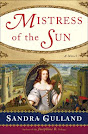
I'm pleased to see Mistress of the Sun featured on the Readers' Circle site this summer. It looks like a good site for book clubs. It will be interesting to see if I'm contacted for a phone chat.

Now that the blog tour is over, the next task my VA (Virtual Assistant) has taken on is to reach out to book clubs. In this world of few print reviews and even fewer book stores, it's hard to know where book club members go for ideas. No doubt a lot is gleaned on-line: but where? The puzzle is to find the sites that might be key.

Wednesday, July 22, 2009

Researchers: what a (cheap) barcode scanner can do for you!

.
.
I admit: I'm fairly stoked about this.

I've been looking for a barcode scanner so that I could load my library into Google Books, searchable from anywhere. (Yes!) However, I didn't want to spend $100. When I saw that LibraryThing sells a scanner for $15, I immediately ordered it.

It arrived today: a cute little CueCat. I plugged it into the USB port and tried to scan a barcode: no dice. Groan, I thought, yet another gadget that does not work. But then — ping! — it did, and now, for whatever reason, it scans easily ... to LibraryThing, but not to Google Books, however.

Back to square one. A quick Google search revealed a way to "de-claw" the Cat, making it so that it works with sites like Google Books. It looked way too complex to me, but I didn't want to buy an expensive scanner, and so I braved workbench, getting into the Cat's intricate innards, and succeeding in changing it so that it works with Google. And yes, I'm proud!

Immediately, and easily, I loaded ten of my books into My Library at Google Books. To test it out, I searched for an unusual name and it immediately came up, letting me know in which book that name was mentioned, and on which pages. I'm one happy camper.

Here's what you need:

The CueCat from LibraryThing.com: here.

How to use the CueCat: here.

Instructions on how to "de-claw" it: here. (A magnifying glass is helpful, as well an exacto knife. And a little patience!)

And, finally, how to scan your books into Google: here.

And yes, in spite of all this diversion, I am meeting my writing goals.

Saturday, July 18, 2009

A pocket recorder saves the day

.
.
I heard literary thriller writer Andrew Pyper give a reading and talk last week, in Eganville, as part of the annual Bonnechere Authors Festival there. I could relate to a lot of what Andrew said: that with each novel he writes, he puts more time into the outline before beginning (check), that he works first thing in the morning (check), that he doesn't emerge until his daily word-quota is met (check) (except that I break for a bowl of cereal at 500 words and then go back).

All authors litter their route with note pads and pencils: there's nothing more frustrating than having an idea and no place to record it. Andrew takes it one step further: he keeps a digital recording device, so that he can dictate ideas as they come, while driving, in the shower, etc.

I love tech gadgets, and so I bought a recorder — a dictation device is the proper name — for under $40. I plan mainly to keep it in the car, where it can be dangerous to write down thoughts ... and where thoughts so often come.

The recorder's first task was an unexpected one, however. I was finishing my chapter this morning (the third this week: right on schedule) when the word processing programme froze. I could see the page I had just written, but I had no option but to reboot and I knew I was going to loose it. So I got the recorder and dictated the passage. I then restarted the computer, played back the recording, typing it in anew. All was well.

It's the type of thing that reminds me how painful it can be to have work disappear. I wouldn't have lost much: I save, back up regularly, and, with every break I take, email the MS to myself. (Yes, paranoid.) However, loosing even a paragraph is painful — vomitous writing, Colette called it — and I'm relieved to have survived this morning's crash with only a scare.

Friday, July 17, 2009

Going into seclusion

.
.
I've been hitting my targets — although Chapter 7, which must be finished on Sunday, is proving challenging. I'm pleased the way the story and the characters are blooming.

But writing makes me dumb in the world — "walking into chairs" is how Margaret Atwood once put it — yet the stuff of life keeps piling up and must be properly attended to. For this reason, I've just now decided to have my VA answer my fan mail for me (in her name, of course). Reading and answering letters from fans is a great joy, a task I'm passing on reluctantly. It's temporary, I reassure myself, until I emerge from this "the swamp."

Monday, July 13, 2009

Mythic Lit

.
.
(At 59 pages ... !)

I saw Mistress of the Sun from the beginning as a fable, and I'm more and more inclined to give way to my urge to create something of a mythic atmosphere in my work, so I was struck by this quote from Alice Hoffman:
"I like to write about real people in mythic ways because I see them that way. The tradition of literature is magic, whether it's fairy tales or Kafka, Shakespeare or the Brontes, and the whole idea of realism is a new and not-so-interesting idea." — Alice Hoffman
That said, it has to feel real both to me and the reader. That's the challenge.
image