Notes on the Writing Life

Notes on the Writing Life

Notes on the Writing Life

Sunday, August 29, 2010

A Revision Rule-of-Thumb

.
In A Writer's Time (a book I recommend), the author Kenneth Atchity describes the state called End Time, when the work at hand is approaching finish. He says:
"End Time is characterized by high energy flow and pressure to finish. ... Think of the slow-moving horse, after an exhausting day in the field, who hears the whistle and gallops at high speed for the barn. ... Lock yourself up if necessary, turn off the phone, leave home, anything to allow End Time its way once you're sure its way can lead to the end."
The Taskmaster (the editor I'm working with now) is cleverly feeding me only three or four chapters at a time to revise. Each section must be right before we move on. With each chunk, I go through all the phases of completing an entire novel, including the exhaustion of End Time.

It's a technique I recommend.

Key to The Taskmaster's technique, as well, is to ask for a slow-motion rewriting of the opening chapters: set the scene, properly introduce the characters, the themes.

In practical terms, for me, it has meant doubling the first 40 or so pages of my manuscript, and doing the same again for the opening of Part Two, where there is huge leap in time and place.

I'd venture to guess that it could be a revision rule-of-thumb: double the first 80 pages of your second draft.

Today I'm in post-End-Time euphoria, the glow that comes with the magical words, The End.

For now ....

Thursday, August 26, 2010

Time management for authors

.
.
I love InkyGirl cartoons:

This is, alas, too true! I start my day with a mug of coffee and the Social Net. Then: to work.

Sunday, August 22, 2010

Novelists: a magpie mind

.
.
I love Sunday mornings with the Ottawa Citizen's wonderful book pages.

This morning I very much enjoyed an interview of David Mitchell, author of Cloud Atlas and, newly-out, The Thousand Autumns of Jacob de Zoet. Here are the passages I highlighted:
"Sometimes I try to write a scene, sometimes a sentence, and I can't get to the end of it without half a morning's research."
I often fall into what I call "The Black Hole" of research when writing, and Mitchell's statement makes me feel better about what I sometimes think is a diversion.
"Novelists ... require a magpie mind."
I love this.

I was thinking the other day about a South American author who said, "I'm a writer. Of course I steal." (If anyone knows the name of this author, I'd love to give him credit.) I am incapable of making things up: I have to find each nugget, each tiny detail. Magpie mind indeed.

On the process of writing, Mitchell said: "It's making something that isn't working work. It's like fixing an engine."

And so, with that, I'll head back into the machine shop ... .

Wednesday, August 18, 2010

A beautiful cover!

.
.
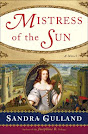
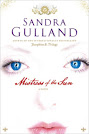
I'm thrilled with the Talpress Czech edition of Mistress of the Sun. It's gorgeous, ribbon bookmark and everything!

Monday, August 9, 2010

In praise of ugly ducklings

.
I've been having a beastly time with the chapters I'm working on now. My characters are not speaking to me. That's a writerly, romantic way of saying I've lost contact with them, I'm not seeing them.

I've hit that patch of despond every writer knows:
"I should give up writing."
"I'm no good at this."
When not writing (that is, wrestling), I've been compulsively reading a wonderful novel: The Lovers by Vendela Vida. It's a short, elegant, emotionally gripping story.

And word perfect — the sort of novel that makes any writer envious. In my present mood, I was flushed with a feeling of awe mixed with inadequacy, and so it was with relief that I read in the acknowledgement the author's long list of readers who had helped the novel through "its early and inelegant forms."

This is a beautiful novel, and I find it perversely reassuring to know that it, too, was once an ugly duckling.

Saturday, August 7, 2010

Lost and found in revision

.
.
This morning, braced by a good sleep, I went through my manuscript scene by scene, listing the changes I would have to make were I to change the Mortemart mansion to the left bank, where I now believe it did exist. (See my early post: here.)

And decided: I would make the move.

Making the decision is half the battle. Making the changes will be painful, but I like the security of place, the foundation of fact. Plus, there's an excellent floor plan: how delicious.

To see my findings, a map and the floor plan: click here.

Friday, August 6, 2010

The problem writing with fact-based fiction

.
.
The problem with writing fact-based fiction is ... well ... facts. They can really mess up a good story.

I'd read that the Mortemarts, the family of Athénaïs, Madame de Montespan, lived on rue de Rosiers.

Perfect: rue des Rosiers is not far from where Claude des Oeillets, my main character, lived when she first came to Paris. It worked into the story perfectly. Their lives do become entwined; nobody knows how their relationship began, but as a novelist it helped that they were walking distance from one another.

Twice I scouted rue de Rosiers on research trips to Paris. I took many photos, but more than that: I walked the cobbles, dreaming.

Unfortunately, I didn't read the fine print at the back of one of the texts. Hôtel Mortemart was on another rue de Rosiers, a street that is now named rue Saint-Guillaume ... far, far from my heroine Claude.

And that's not entirely certain, either. Some accounts claim that Hôtel Mortemart on rue Saint-Guillaume was built in 1663—three years after the young women meet.

So where were the Mortemarts living in 1660?

I've spent all morning researching possibilities (when I should have been writing). Vivonne, the eldest child, was born in the Tuileries palace. Both high-ranking parents served the King and Queen for three months of the year, and were likely entitled to live there ... so that's a possibility, although they certainly would have had a residence of their own in Paris.

I'm not really sure what I'm going to do about this. I could leave the setting as it is and make a note about the change in the Author's Note or on my website.

Or I could change it, place the Mortemarts either in the Tuileries or on rue Saint-Guillaume ...  difficult, and not necessarily good for the story.

I'm still perplexed.

Tuesday, August 3, 2010

Beginning, again and again

.
.
Editor Dan, who I will now refer to as The Taskmaster, is taking me through the manuscript revision slowly. The first 40 pages became 100. Now I've only 20 pages to work on—the first chapters of Part II—but it feels like looking up at Mount Everest.

I keep thinking: non-fiction would be so much easier. Easier to describe the dead than to try to bring them back to life.

Once again, I'm somewhat at a loss where to begin, how to begin. One consolation of experience is that I know that once I do, I will feel much more at ease.

Temptation: coffee.  I must resist (I've given up caffeine); I'll console myself with breakfast popcorn, the perfect anxiety snack. 

Friday, July 16, 2010

Revision: shoving the MS back into the womb

.
.
What does a writer do when a manuscript is with an editor? Clean closets, shop, throw stuff out, look for mouse nests, tame the desktop. In short: house attack. This is arduous work, and I'm very much looking forward to getting back to writing.

Not that there isn't writing work I should be doing: research, for one, taking notes. I've yet to organize my notes from my latest research trip to Europe, for example.

But for now, something from the book pages of the Ottawa Citizen. (A wonderful book page that hasn't expired!)

The quote, which is spot on with respect to the revision process, is from author Sloane Crosley, author of How Did You Get This Number?
"I am handing in a draft and we will see what happens. Trying to shove it back into the womb and have it come out something else is a very tricky experience as it looks familiar, but is a bit off...." 
Indeed!

Sunday, July 4, 2010

Old-fashioned keyboard + iPad: perfect

.
.


*****
Website: http://www.sandragulland.com/
Blog: http://sandragulland.blogspot.com/
Facebook: http://bit.ly/sgullandFacebook
Twitter: http://twitter.com/Sandra_Gulland
Tumblr: http://sandragulland.tumblr.com/

Saturday, July 3, 2010

Blowing on a dead man's embers: the process of writing historical fiction

.
.
I've been struggling with the third draft of The Next Novel, in part because it has been taking me so long to get these first four chapters moving. It's July already!

In off hours, I've been working on a guest blog on the definition of historical fiction, and in going through my files I discovered the first stanza from a wonderful poem by Robert Graves:
To bring the dead to life
Is no great magic.
Few are wholly dead:
Blow on a dead man's embers
And a live flame will start.
I'm blowing on the embers: blowing, blowing … .

To read the rest of "To Bring the Dead to Life," so evocative of the process of writing historical fiction: click here.

Thursday, July 1, 2010

iPad: an indespensible research tool

.
.
Historical Fiction author Susan Holloway Scott asked: 
OK, Sandra, so now you've had the iPad for a week. Has it totally changed your life, or at least has it been as much fun as Apple promises?
To answer: my iPad has quickly become an essential tool for research. Among other things, I can read and annotate PDF files and e-books on it: notes, highlights, underlined passages. I can send the annotated files to my computer (or just the annotations). These I can then put into a searchable database on my computer. 

Mind-blowing! Usually my research is in two steps: 1) read and make notes, 2) type notes onto the computer. This last step is a killer. With the iPad, it's just one step. Plus, I'm not printing out PDF files, which is expensive. Too, a library of printed-out files is not portable.

It took a while to work out to read and annotate PDF files on my iPad. It's not exactly transparent, but once I sorted it out, it's easy to do. Here's what I discovered:

For PDF files:

1) Download the iAnnotate app. It's worth every penny. Ignore everything they say about using other apps. 

2) To put PDF files into iAnnotate (or any other reader): 

--Connect your iPad to your computer and open iTunes. 

--Select iPad on the left, and go to the Apps tab. 

--Scroll down to where it says "File Sharing." There you see two windows. Select iAnnotate on the left. 

--Click the "Add button, which shows up on towards the bottom right of the right hand pane

-- Find your file and click "open"


For e-books:

1) Download the Kindle app (free). 

2) On the iPad, go to the Kindle store and download a book. 

3) Click any word in the book and a box appears. Stretch it over the area of interest and select highlight or note. (You can do both by clicking again.) 

4) On your computer, to see your notes and highlights, log into your account on Kindle (http://kindle.amazon.com/) and click "Your highlights." Copy and paste your highlighted text and notes into Evernote, a word file or whatever database program you use.

Note that you can convert any document into a PDF file and upload it to either iAnnotate or the Kindle app on your iPad. In other words: you can read and annotate your own manuscript or someone else's manuscript on an iPad. No more printing out 500 page texts (at least not so often).

Note, as well, that many of the out-of-print texts so delicious to historical researchers can be downloaded from Books Google or other on-line libraries. Now they can be easily read and annotated. 

It's rumored that GoodReads and other reader apps will be adding annotation features. For now, iAnnotate and Kindle are the best ways to go. 

Game changer? You bet.

Monday, June 21, 2010

Crawling through a story

.
.
I'm still struggling with the first section of The Next Novel. Putting scenes under a microscope, I realize how much I've left unsaid — unimagined.
How exactly do they get into the city? By what route?
Do they need papers?
What are they wearing?
What are they seeing, experiencing, feeling?
Where will they stay the night?
How will they lock up their things?
What about the donkey! Doesn't she need food and water?
On one level the revision process has to do with the big picture: the movement of energy from one scene to another. On another level it has to do with the little picture, the microscopic view, with bringing scenes to life through detail. Both are the work of the 3rd draft.

I often think of Ariel Gore's summation of the writing process: lather and rinse, lather and rinse. I'm at a lather stage, but I wish it were that easy. It feels, instead, like crawling through a story, groping in the dark. It can be painstaking, and often, for me, requires quite a bit of research. It's slow going — but then, as I've said many times before, beginnings are the hardest.

Wednesday, June 16, 2010

Talking to Book Clubs: Skype challenges

.
.
I love talking to book clubs, and the internet has made virtual meets possible, through Skype. However, I find that there are often problems with Skype: the screen goes black, or freezes. Sometimes I can hear, but not see. At other times I can see, but not hear, and often there is a lag in the communication, or annoying warbling gaps. It reminds me of talking on the old one-way radios we used in the artic thirty years ago.

I presume that these problems have to do with the quality of the Net connection—its speed and width—and possibly with the computers themselves.

I'm pleased that talking with the wonderful Mont-Tremblant Bookmarks Book Club last night, we came up with a solution. Here's what I suggest:
1) Plan on Skype but have on hand, as well, a telephone with a speaker-phone feature.

2) Connect with Skype. If (when) it proves frustrating, turn off the sound on the computer and telephone, instead. That way, you are talking over speaker-phone, but you can also see each other, which is nice. 
In short: it works.

The Club asked how to structure the hour that we had scheduled. I suggested that they each come up with a question (or two), and come to the screen one by one. This was wonderful--I got to meet each member one-on-one (with the others watching), and their questions were excellent. The hour flew by!

The next time I do this, I will see if I can move the little Skype image of myself to the upper corner of the screen so that I'm not always looking down to check if I'm in view. (Better to be looking up.) I will also use my hands-free telephone mike so that I have more freedom of movement.

Friday, June 11, 2010

Digging deep: the 3rd draft

.
.
I imagined that I could write the 3rd draft of The Next Novel this summer, but I forgot how difficult the 3rd draft can be: it digs deep. I imagine that the 4th and 5th drafts will be on the down-hill slope, but for now, just starting on the 3rd, it's all up-hill.

It's a little confusing knowing how to proceed. Dan wants me to take my time on the first section. It's only 40 pages, but it's the most important part of the novel. Everything that happens comes out of these pages.

I need a plan. Because so much has to be re-visioned (re-imagined), I decided to retype it, rewriting as I go. I'm aiming to double the length, and then edit, cutting it back. Could I finish this section this month?

I began this morning setting out 10 pages. I had no way of knowing how many pages I might get through in a day. I hoped it would be more, but I thought 10 pages a fair estimate.

I got through 3 and 1/2: at this pace, the 479-page MS will take almost 7 months.

Beginnings are always the hardest.

Wednesday, June 9, 2010

"Right Place, Right Time" — my father's book

.
.
I'm terribly pleased with the book I put together (through lulu.com) of my father's wonderful stories and essays.


It's a 60-page trade paperback, and even with taxes and handling the 20 books I ordered came in at around $6 U.S. a copy. I didn't choose to make my father's book public, or to offer it for sale on-line and give it an ISBN number, etc., but all these would have been possible.

It took some fiddling to get it right (especially the cover images), but now that I have the hang of it, I'm dying to do more.

I could get addicted to self-publishing!

Monday, June 7, 2010

Post-conference highs (and lows)

.
.
I've been negligent, not reporting in. Usually that means that there's too much to say. I'll begin in brief:

Editor Dan read my manuscript. He did not say "It's perfect." He raises the bar high (and that's what I want from him), but all the while I'm inwardly groaning, wanting to play. I feel that way now — but once I'm in the thick of it, that will be where I want to be.

In preparation for rewriting The Next Novel, began rereading Mistress of the Sun: I could so easily take a pencil to it!

I went to The Writers' Union of Canada AGM in Ottawa: it was fantastic. If you are a published Canadian writer, and not a member, I urge you to join. TWUC does important work, and it also offers benefits.

Some time ago I posted advice to a newly-published author (here). I advised him to join PLR (Public Lending Right), but at the time I didn't even know about Access Copyright. I was late signing up with PLR: this oversight cost me over a thousand dollars, but failing to join Access Copyright at least doubles that. I'm chagrined. Don't make my mistake!

I'm putting together a Lulu.com book of my father's writing, hoping to get it "published" before Dan's edit arrives. It's frustrating living with slow and often faulty internet, but the book is almost there.

Of course, with all this, I'm frittering time looking into new and different ways to create yet another blog (for family travel) and anxiously awaiting my iPad, which I just learned will not arrive until mid-month. (Just as well.) 

More anon ... .

Sunday, May 30, 2010

First reader and other fears

.
.
The second draft of The Next Novel is being read right now by Dan Smetanka, a wonderful free lance editor in L.A. Am I nervous? You bet! This is its first public airing. In preparation for the next revision — the third draft — I'm rereading it myself. I've been dreading doing this, but now that I'm a good 100 pages in, I feel more at ease.

Not that there aren't problems, both big and small. I've a lot of work ahead. I marvel at the writers who are able to create a coherent novel in a year or two.

The small problems are almost amusing. Who was the author who advised his daughter, also a writer, to "always make sure that the moon is in the right place"? This is basically saying: attend to the details. I had to laugh: one scene opens in spring and in the course of a few hours moves into fall and then winter. It's a good thing Dan has a sense of humor.

Monday, May 24, 2010

Travel research tips for writers of historical fiction

.
.
I recently received this e-mail from a reader: 
I am working on a manuscript of historical fiction and plan on traveling to the sites associated with my tale (Wales).  I was wondering if you had any advice you could share as to how you visit the places in your stories.  How do you absorb/experience them in a way that you take into your writing? Given your current travels in France, I thought this would be a particularly opportune time to ask.  
Because of the travel complications this spring (due to volcanic ash), I had to consider the possibility of finishing the novel I'm working on now without travel research. I'd done quite a bit of research on my last trip, and I thought it might be possible to manage, given how much is available on-line.

Wrong!

We'll be back home in Canada in a few days, and once my head clears, I'll dive into writing the third draft. I'm already dizzy with the realization of how much will need to be changed due to the "on-the-ground" research I've done.

When I started travel research for the first of the Josephine B. Trilogy, I was overcome with the feeling of presence. "Josephine walked here." Experiencing a character's tangible reality was important to me ... and it continues to be, for every book I write. Having a feel for a character's physical world gives me a certain authority when writing.

But also, for me, it's a lot about logistics: how did she get from here to there? What were the dimensions of her world?

In other words, facts of the type that are difficult to convey in print.

I also find that there can be wonderful books available in museums that are difficult to discover otherwise. I always check the children's section, as well. This trip, I found a wonderful illustrated children's book on the building of Versailles. Since Versailles was in the process of being built during the period I'm writing about, this was a find!

Practical tools

On the practical side, I find it important to wear a (not very flattering) "fanny pack" with all my tools easily at hand: camera (well charged), pencil, notepad, map, money, etc.

This trip I discovered that a recording device is indispensable. (Sometimes I'll have a camera in one hand, and the recording device in the other.)

I photograph display information that I can then put into Evernote (which then become searchable). I photograph street signs and spots on a map so that I know, once home, what the photographs following are of.

Creating a special map with Google map has been a very helpful on-line tool for keeping track of all the sites relevant to this novel.

I hope this helps! I'd love to hear from others about their travel research tips.

Tuesday, May 11, 2010

Forging historical fiction when facts differ — or are scarce

.
.
In response to a question on a historical fiction list about forging fiction from little fact (or from differing "facts"), historical author Elizabeth Chadwick posted this wonderful answer:
You do as much background research as you can, both the narrow and the broad, into the person, their lifestyle, and the times in which they lived.
If there's not a lot available about them, then you research the people who interacted with them — their lifestyles, and the people who in turn interacted with them. 
You dig and then you dig some more. This way you build up the layers in the picture and get a feel for what's right and what's not. 
... If you do the research in enough depth, your story will have the integrity that does history, you, and the reader justice. 
How you utilize your research in the novel is down to your personal skills as a writer. Both story and history need to come alive for the reader and shine. No one can be 100% accurate and as writers our imagination is perhaps the most essential tool in our kit, but integrity matters I think.
If you are writing about someone who actually lived, then you keep as close to their personality as you can and portray their world as it actually was — or as close as you can get, and that includes attitudes as well as furniture. If your characters are imaginary then the same. That's my take on it anyway - for what it's worth :- )
(The emphasis is my own.)

I'm in Paris now, doing research. So much rewriting ahead! As always, I find on-the-ground research essential.


Tumblr: http://sandragulland.tumblr.com/
 

Tuesday, May 4, 2010

.
.
I get wonderful emails from readers, but this charming account especially moved me.
Dear Ms Gulland

Some people have said that I should not make the following admission but I
have, on a number of occasions, fallen foul of female acquaintances when I
have occasionally admitted that, as a male baby boomer privately educated in
the UK, I tend to overlook books by female authors. I can only be truthful,
and have always put it down to education and "conditioning" by the boys'
school I attended, along with its male-dominated reading lists.

On Friday last I found myself in the Sydney City Library and decided, on the
spur of the moment, to borrow the first book by a female author that my eye
landed on. It was "The Many Lives...." and I have not been able to put it
down over the weekend. It has turned out to be one of the most enjoyable
"penances" I have ever received.

You will probably be disappointed that I did not buy the book, but I do
intend to buy the sequels.

Thank you.

Stephen Baddeley
When asked permission to quote his letter on this blog, Stephen added:
My city library does have the balance of the trilogy on the shelf, but only the third book was available when I checked. It is ever thus with lending libraries, so I reserved the 2nd part of the trilogy and naturally took possession of the Last Great Dance ...
Last weekend I couldn't wait to follow the sequence and started the third book regardless. Apart from work and golf, I haven't put it down, and I have had to explain to fellow golfers why I have been reading these books at the club before each round, rather than gathering with them on the veranda for a drink before the round!
My imagined reader is a woman, but I like to think that my novels appeal to men, as well.

Thank you, Stephen!

Monday, May 3, 2010

Joyce Carol Oates on "biographically fueled fiction"

.
.
Fact-based fiction? Biographical fiction? What does one call fiction that is based on the life of a historical character. I like Joyce Carol Oates' expression: "biographically fueled fiction."

Here's what she had to say about it in a review of a biographical novel about Emily Dickinson in the New York Review of Books:
In these exemplary works of biographically fueled fiction it's as if the postmodernist impulse to rewrite and revise the past has been balanced by a more Romantic wish to reenter, renew, and revitalize the past: not to suggest an ironic distance from its inhabitants but to honor them by granting them life again, including always the stumbling hesitations, misfires, and despair of actual life....
Just a snippet ... I'm packing for France: research with wine and cheese!

Thursday, April 29, 2010

Going public: Marketing 301

.
.
I very much like this blog post by Robin Black on book promotion, especially:
Whatever your natural inclinations, as an author with a book to sell, you are going to have to become (or fake being) outgoing, highly sociable and downright thrilled to be stared at by—if you’re very, very lucky—a crowd. Not to mention grateful, which is actually very important.   

Related posts: 
Net marketing for Ludites: Part 1
Net Marketing for Luddites: Part 2 (Cracking the Social Net)
Net Marketing for Luddites: Part 3 (Blog? Website? Both?)
Net Marketing for Ludites: Part 4 (Friends & Followers)
Net Marketing for Luddites: Part 5 (The Book Trailer)
Net Marketing for Luddites: Part 6 (Your Fans)

Tumblr: http://sandragulland.tumblr.com/ 

Hola, Hello, Bonjour!

Here is my latest newsletter: 

http://bit.ly/SGnewsletter
And here is the correction I immediately had to send out regarding the date of my Paris reading. (I've also added some details about it.): 
http://bit.ly/Parisreading

Come join me in Paris -- why not? 

Wednesday, April 28, 2010

Contract love

.
.
I love my Canadian publisher, HarperCollins Canada. After a winter away, I came home to a pile of mail, including the contract for The Next Novel. I don't get a new book out that often, so I forget how striking the first page of their contracts is. It reads:
We believe that a book's most precious element is its creator; that the publisher's role is to produce a work of lasting value and offer it to the public with confidence and commitment; that the author's opinions on publication matters are relevant and should be heard; and that quality should be as much of the essence as timeliness in this agreement. Our contract expresses these beliefs. 
See?
image